Loose hair does not tell you which grooming tool to reach for. A regular brush works on the coat’s surface, helps with light tangles, and gives you a chance to check the skin. An undercoat deshedding tool reaches below the topcoat to lift loose undercoat. Those are different jobs.
For a senior dog, coat type is only the first check. Skin condition, pain, balance, and tolerance matter just as much. A tool that matches the coat can still be the wrong choice on a sore day.
The quick choice: brush or undercoat tool?
| What you are trying to do | Start with | Pause when |
|---|---|---|
| Remove surface debris, smooth the coat, or work through a few loose tangles | A coat-appropriate brush or comb | The tool catches, the skin moves with the stroke, or your dog flinches |
| Lift loose undercoat from a shedding dog with a true undercoat | An undercoat deshedding tool, only on a dry, unmatted coat | You find redness, sores, bruising, tender areas, or particularly sensitive skin |
| Deal with a tight mat, felted coat, or painful clump close to the skin | Professional grooming or veterinary help | Do not pull harder, repeatedly rake the area, or put scissors next to hidden skin |
| Groom a dog who is newly stiff, irritable, unsteady, or unwilling to be touched | A veterinary check before changing tools | A new behavior change can be a pain sign rather than a grooming problem |
If you are unsure whether your dog has an undercoat, ask a groomer or veterinary professional who can examine the coat in person. “Long hair” and “heavy shedding” do not answer that question by themselves.
Before the coat, check the skin and the whole dog
Part the coat in several places before brushing. Look behind the ears, under the front legs, around the collar area, along the back, and near the hindquarters. You are checking for redness, scabs, sores, bald patches, unusual thinning, fleas or flea dirt, and areas where a light touch bothers your dog.
The ASPCA advises veterinary attention for skin irritation, open sores, bald areas, unusual hair loss, or persistent scratching, licking, and chewing. A grooming tool cannot diagnose or treat those changes. Brushing over them may make an uncomfortable area worse.
Then watch how your dog gets into position. Cornell’s osteoarthritis guidance lists stiffness, gait changes, difficulty getting up, reduced activity, irritability, and aggression among possible signs of pain. If your dog suddenly resists a familiar brush, do not assume stubbornness. The sore part may be the shoulder, back, hip, or leg needed to stand through the session.
Stop and call your veterinarian if grooming reveals a wound, infected-looking skin, a new lump, unexplained bald patch, marked tenderness, or a sudden change in movement or behavior. Seek professional grooming help for a tightly matted coat. Do not try to win a tug-of-war with the mat.
Start with coat type, not the dog’s age
Older dogs do not all need a softer version of the same brush. Their coats still differ. The ASPCA’s grooming guidance changes the tool by coat type, which is more useful than shopping by an age label.
Smooth, short coats
A rubber grooming brush or short, flexible bristles may be enough to loosen surface hair and dirt. Follow with a soft bristle brush if the dog enjoys it. An undercoat tool is not the default for a smooth coat, especially when there is no distinct undercoat.
Short, dense coats
A slicker or other coat-appropriate brush can deal with light tangles and surface hair. Some short, dense coats also have a shedding undercoat. That is where a correctly sized undercoat tool may have a separate role, but only after the coat is dry, free of mats, and comfortable to touch.
Long or silky coats
These coats often need a brush and comb used in small sections. The goal is to find a snag before pulling through it. Long hair does not automatically mean an undercoat tool belongs in the routine. Confirm whether an undercoat is present and whether the tool’s current instructions cover that coat.
Curly or continuously growing coats
These coats may need frequent brushing and professional trimming, but they are not the same as a shedding double coat. FURminator’s current undercoat-tool instructions say not to use that tool on non-shedding breeds. A groomer who knows the coat can help match a slicker, comb, and trimming schedule without treating every loose curl as undercoat.
When an ordinary brush is the better starting point
Choose a brush when the job is routine coat care: removing debris, smoothing the surface, checking the skin, or easing out minor tangles that release without pulling. The live Senior Dog Grooming & Clean Home Products guide includes a current pin-and-bristle example. The bristle and pin surfaces do different jobs; the brand name does not decide which one suits the coat.
On FURminator’s current dual-brush instructions, the bristle side is described as an all-around surface and finishing brush for most coat types, while the pin side is intended for longer coats. The company directs users to brush with hair growth and avoid excessive strokes in one area because repeated passes can irritate the coat and skin.
That last point matters with an older dog. More strokes are not automatically better. Use enough pressure to move through the coat without dragging the skin. If the brush catches, stop and separate the hair with your fingers or a suitable comb rather than pulling the dog’s body toward you.
A brush is a sensible first choice when:
- The coat needs surface cleaning, smoothing, or a light tangle check.
- You are still learning where your dog tolerates touch.
- The dog does not have a confirmed shedding undercoat.
- You want to inspect one small area before deciding whether another tool is needed.
When an undercoat deshedding tool may fit
An undercoat tool has a narrower job. It reaches through the topcoat to collect loose undercoat from a dog who sheds and has an undercoat. It is not a faster brush, a dematting tool, or a treatment for abnormal hair loss.
FURminator’s current directions for one of its dog undercoat tools require a completely dry coat and a physical skin check first. The manufacturer also says to clear tangles and mats before using the tool, stroke with the direction of hair growth, use light pressure, avoid repeated passes over one spot, and stop for redness or irritation. Its instructions exclude non-shedding breeds and pets with particularly sensitive skin.
The manufacturer’s general schedule is one or two sessions a week for 10 to 20 minutes, depending on breed and coat. Treat that as an upper routine supplied by the maker, not a target your senior dog must complete. One comfortable section may be plenty. Fatigue, shifting weight, looking back at the tool, skin movement, or an attempt to leave means the session has given you useful information. Stop.
An undercoat tool may be reasonable when:
- Your dog has a confirmed shedding undercoat.
- The coat is fully dry and free of mats and tangles.
- The skin looks healthy and accepts light contact.
- You can keep the tool flat enough to use gentle strokes with hair growth.
- Your dog can stand or lie comfortably on stable footing for a brief section.
Skip it for now when:
- The coat is damp, tangled, tightly matted, or packed against the skin.
- Your dog has sores, bruising, redness, bald patches, or a tender area.
- The breed has a non-shedding coat or no clear undercoat.
- Your dog repeatedly turns, flinches, freezes, pants, or tries to move away.
- You are trying to fix sudden or excessive hair loss. That belongs with your veterinarian.
A mat is a separate problem
A brush may loosen a small surface tangle. A deshedding tool removes loose undercoat. Neither fact makes it safe to rake through a tight mat.
Matted hair can sit close to the skin and hide irritation. Repeated brushing may pull the skin with every stroke. If you cannot see where the coat ends and the skin begins, or if the mat is broad, hard, or painful, stop. A qualified groomer or veterinarian can decide how to remove it with less risk.
Do not slide scissors under a mat. Dog skin can be drawn up into the coat, and the gap you think you see may not be a safe cutting space. Also avoid bathing a matted area in hopes that water will loosen it. The ASPCA recommends brushing out dead hair and mats before a bath.
Run a two-minute tolerance check
You do not need to finish the dog to learn whether the setup works.
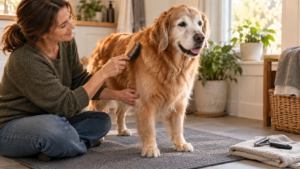
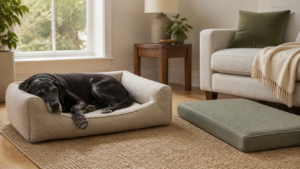
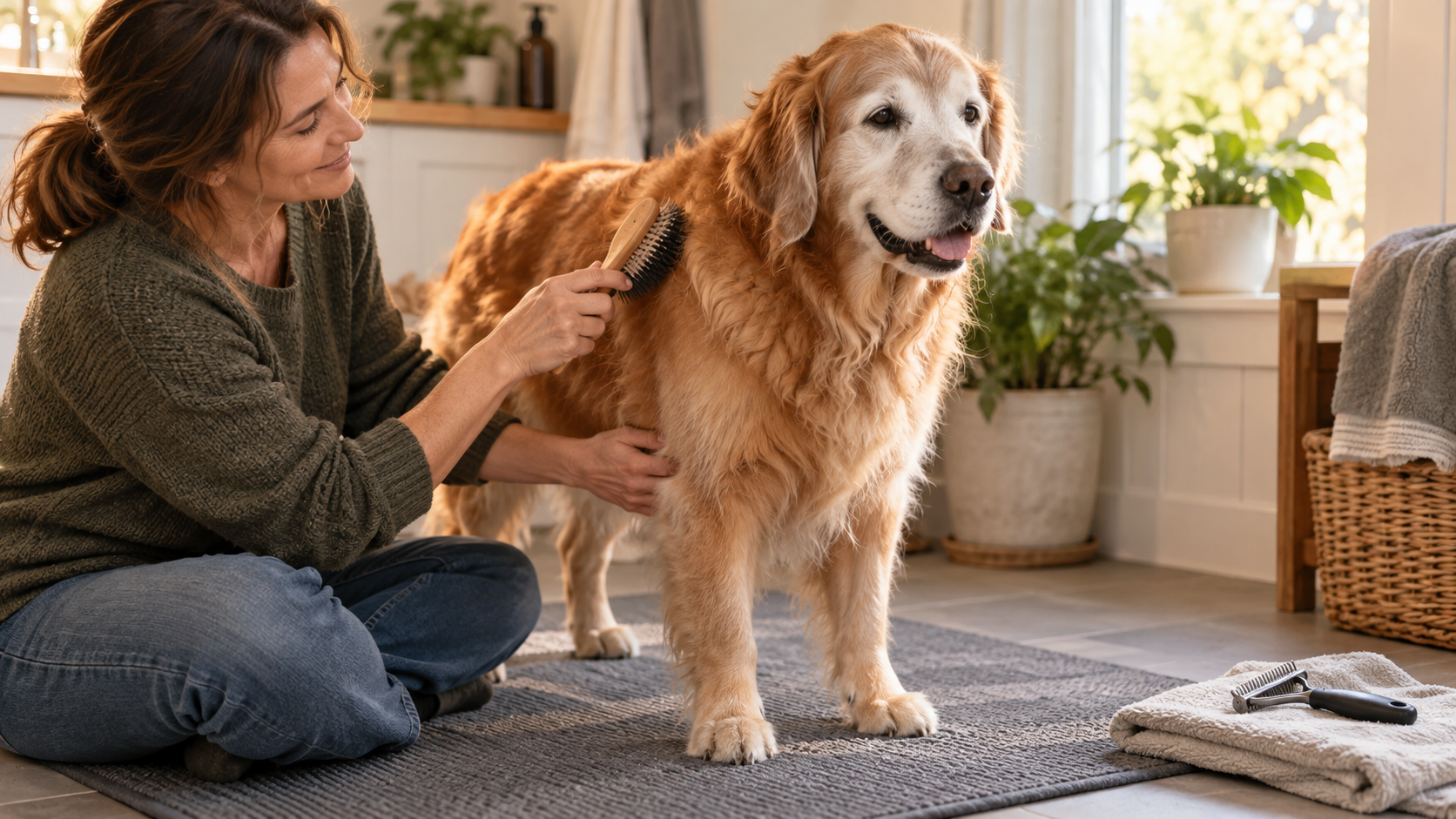
- Choose the position first. Use a wide, dry nonslip mat at floor level. Let your dog stand or lie down without twisting a leg into place.
- Start with your hand. Touch the shoulder or side, then move one short section of coat with your fingers. Stop if that alone causes a flinch or turn.
- Show the tool before using it. Let your dog see and sniff it without pushing it toward the face.
- Make one light stroke. Follow hair growth. Keep the first stroke away from bony points, the belly, genitals, and any questionable skin.
- Pause on purpose. Remove the tool and give your dog room to remain or move away. A dog who steps away has answered the question for this session.
- Check the skin again. Look for redness and feel whether the area seems warmer or more sensitive than it did before.
If one short area goes well, you can do another. If it does not, changing tools immediately may only repeat the problem. End the session and work out whether the issue is coat, skin, position, fatigue, fear, or pain.
A simple decision path
- Is the skin abnormal or touch newly painful? Stop and contact your veterinarian.
- Is the coat tightly matted? Ask a qualified groomer or veterinarian for help instead of pulling or cutting near hidden skin.
- Does the dog have a confirmed shedding undercoat? If no or uncertain, start with a coat-appropriate brush or ask for an in-person recommendation.
- Is the job surface care or light tangles? Use the appropriate brush or comb with short, gentle strokes.
- Is the job loose undercoat on a dry, unmatted coat? A correctly sized undercoat tool may fit if the current instructions cover the coat and the dog tolerates it.
- Does your dog stay comfortable after one small section? Continue briefly or stop there. Finishing the whole coat is not required.
A brush handles surface coat care. An undercoat tool lifts loose undercoat from a suitable shedding coat. Start with that job, check the skin, and let your dog’s response set the length of the session.
For bathing, which adds footing, water, and exit-route questions, read How to Set Up a Safer Bath for a Senior Dog. If home grooming has become difficult, our guide to choosing a dog groomer can help you ask about coat experience, breaks, handling, and communication.
Research note: This is a coat-care decision guide, not a hands-on product test. Well Walked Dog did not test the tools discussed here. Tool designs and instructions can change, so confirm the current directions for the exact tool and size you use.
Sources
- ASPCA: Dog Grooming Tips, accessed September 15, 2026. Coat-based brushing, skin checks, matting, shedding, and veterinary escalation.
- FURminator: Dual Grooming Brush for Dogs & Cats, accessed September 15, 2026. Current manufacturer brush surfaces and directions.
- FURminator: Undercoat deShedding Tool, Large Dog, Long Hair, accessed September 15, 2026. Current manufacturer use limits, skin checks, coat preparation, stroke direction, and session guidance.
- Cornell University College of Veterinary Medicine: Osteoarthritis, accessed September 15, 2026. Pain, stiffness, movement, and behavior signs.