
Research-backed product guide
Match the support to the job your senior dog needs help doing
A long ramp, a full-body lifting harness, and a simple rear sling solve very different problems. This guide organizes six researched options by use case, fit, measurements, care, and documented limitations.
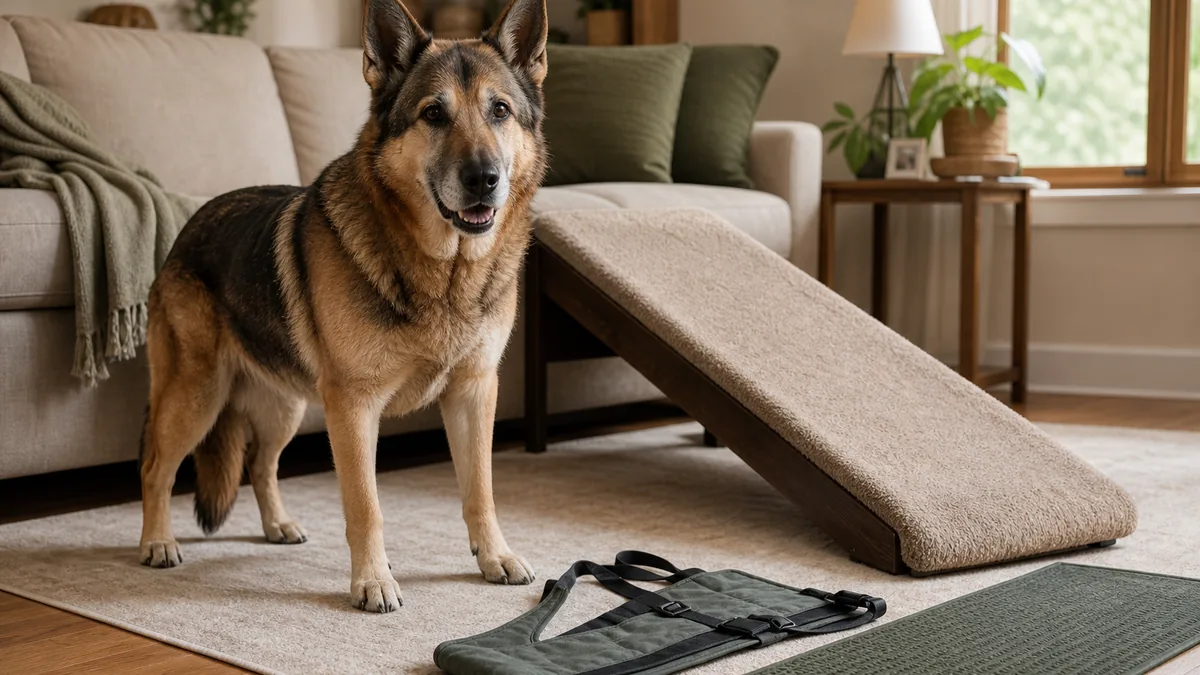
Quick picks by need
Start with the task, not the brand
These labels describe distinct use cases. They are not numerical rankings or claims that one product is universally best.
Before choosing a mobility aid
A mobility product can help manage an everyday obstacle, but it cannot explain why your dog is struggling. Sudden weakness, collapse, severe pain, dragging a limb, inability to stand, or a rapid change in walking deserves prompt veterinary attention. If the change is gradual, mention it at your dog’s next appointment and ask whether a particular type of support is appropriate.
Start by identifying the actual job:
- Standing up: A rear sling may be enough when the front legs remain strong. A full-body harness provides more balanced support when both ends need help.
- Getting into a vehicle: Measure the ground-to-entry height, available ramp length, door opening, and storage space. A shorter ramp at the same height creates a steeper climb.
- Reaching a bed or sofa: Check the furniture height, step rise, tread depth, floor grip, and whether your dog can safely repeat a stepping motion.
- Walking and bathroom trips: Look for a secure fit, comfortable padding, bathroom clearance, and a handle height that does not force you to bend awkwardly.
Weight capacity is only one part of fit. A product can support your dog’s weight and still be too narrow, too steep, poorly positioned for a male dog, or uncomfortable around sensitive skin.
Help ’Em Up Harness with Hip Lift
Best suited for: Full-body support for dogs that need help at both the shoulders and hips.
The Help ’Em Up Harness uses a two-piece shoulder-and-hip design with separate handles over the front and rear. Its padded structure supports beneath the sternum and pelvis instead of relying on a narrow belly strap. This makes it the most complete lifting system in this group for getting up, negotiating a few stairs, entering a vehicle, or following a veterinarian-directed rehabilitation routine.
- Current manufacturer weight bands: X-Small 10–25 pounds, Small 25–45, Medium 45–80, Large 80–125, and X-Large 125–225.
- Adjustment: Eleven adjustment points are documented, but measurements still matter more than weight alone.
- Care: Nylon tubing with neoprene padding and fabric lining; the reviewed care instructions call for delicate machine washing with mild detergent and air drying.
- Male-dog fit: The maker offers different rear configurations, including a U-Band option for some male anatomies.
- Documented warranty: One year against defects in materials and workmanship in the reviewed product documentation.
Important limitation: This is lifting and stabilization equipment, not something to leave on indefinitely without checking the dog. Remove or loosen it during rest as directed, preferably remove it overnight, and watch for moisture, chafing, hot spots, or overheating—especially with fragile skin or incontinence. The current online weight selector and an older fitting document use different weight bands, so confirm the current manufacturer measurements before choosing a size.
GingerLead Dog Support & Rehabilitation Harness
Best suited for: Quick rear or belly support during bathroom trips, short walks, and stairs.
The GingerLead combines a padded support sling with an integrated leash and adjustable handle. It is quicker and simpler than a full-body system when a dog’s front legs remain reliable and the handler mainly needs to steady the rear.
- Capacity: The manufacturer states support for dogs up to 250 pounds, but sizing is based on usable pad width and total strap length—not weight alone.
- Materials: Pack-cloth exterior with soft corduroy at the support pad; the Mini version uses neoprene.
- Care: Standard versions are described as machine washable and dryable; the Mini should air dry.
- Positioning: Medium, Large, and Tall versions include optional stay-on straps to help hold the pad in position when the handle is released.
Important limitation: This is rear/belly support and does not include a chest harness. The manufacturer recommends adding a standard chest harness when more control is needed, especially while descending stairs. Measure the usable space immediately in front of the hind legs—and in front of the penis for a male dog—to make sure the support pad can sit in the correct place. Never leave a support sling on an unsupervised dog or overnight.
The Original Walkabout Back End Harness
Best suited for: Hindquarter support with a more secured leg-opening design.
The Original Walkabout Back End Harness uses two padded rear-leg openings plus torso support. That design may appeal to caregivers who want the harness to stay more consistently positioned than a simple towel-style sling while the dog’s front legs continue to do most of the walking.
- Fit measurements: Measure the abdomen immediately in front of the rear legs and the upper thigh where the leg meets the body.
- Range: Multiple sizes are available, and longer straps or amputation-specific configurations may be requested from the maker.
- Care: Reviewed retailer instructions call for warm machine washing and line drying.
- Bathroom access: The manufacturer describes the design as allowing bathroom breaks for male and female dogs, but individual anatomy and fit still need to be checked.
Important limitation: This remains rear-only support. The maker says the harness can remain on for extended periods, but we did not find clear instructions supporting unattended or overnight use. Check the fit frequently and keep it clean and dry. The detailed size chart and wash instructions we reviewed were retailer documentation, so verify the latest chart with the manufacturer before ordering.
PetSafe Happy Ride Telescoping Dog Ramp
Best suited for: Adjustable vehicle access when a longer, gentler approach is possible.
The PetSafe Happy Ride Telescoping Dog Ramp extends from 39 to 72 inches, allowing the handler to use more length where space permits. The current manufacturer model is PTV17-16898. It uses an aluminum frame, high-traction tread, side rails, a carrying handle, and a latch that keeps it closed during storage.
- Open dimensions: 39–72 inches long, 17 inches wide, and 4 inches high.
- Product weight: 13 pounds.
- Stated capacity: 400 pounds.
- Storage: Telescopes down to approximately 39 inches long.
Important limitation: PetSafe specifies vehicle heights up to 28 inches. Measure your entry height and the ground space available for the ramp. Do not shorten the ramp simply to make it fit if that creates an angle your dog cannot manage safely. Train with the ramp low and stable before using it at a vehicle, and supervise every crossing.
Pet Gear Extra-Wide Free-Standing Pet Ramp
Best suited for: A fixed-height freestanding ramp that does not rest on the vehicle bumper.
The Pet Gear Extra-Wide Free-Standing Pet Ramp, product series PG9956XL, supports itself instead of leaning on the bumper. It has a slip-resistant walking surface, raised edges, a support panel, rubberized bottom grippers, and folding support braces.
- Open dimensions: 55 inches long, 19.25 inches wide, and 23 inches high.
- Product weight: 19 pounds.
- Stated capacity: 300 pounds.
- Documented warranty: A 30-day non-transferable limited warranty for the original retail purchaser, with proof of purchase required.
Important limitation: The working height is fixed at 23 inches. That makes careful vehicle measurement essential; a freestanding design is not helpful if the entry point is significantly higher or lower. Follow the manual when locking the center support and arm braces, protect your fingers from folding pinch points, and never leave a dog unattended on the ramp.
PetSafe CozyUp Folding Pet Steps
Best suited for: Compact indoor access when a senior dog can still use shallow, repeated steps comfortably.
The PetSafe CozyUp Folding Pet Steps use a BPA-free polypropylene frame, fabric treads, side rails, and nonskid feet. They fold relatively flat, making them easier to store than many continuous furniture ramps.
- 20-inch version, model ZTV00-17045: 24 × 16 × 20 inches open, 30 × 16 × 5 inches folded, with a stated 150-pound capacity. Approximate step rise is 4.75 inches.
- 25-inch version, model 62398: 28 × 18 × 25 inches open, 36 × 19 × 6 inches folded, with a stated 200-pound capacity. Approximate step rise is 6.25 inches.
- Traction: Fabric treads are replaceable, and high-traction replacement treads are available from the maker.
Important limitation: Steps are not automatically easier than a ramp. They require repeated joint flexion and balance on each tread. A dog with significant weakness, pain, poor vision, or trouble placing the feet may do better with a stable low-angle ramp or may need the furniture made inaccessible. Measure furniture height and watch your dog’s movement rather than choosing only by the advertised weight capacity.
What we did not recommend yet
Dog wheelchairs and highly specialized mobility carts can be life-changing for the right dog, but fit depends on diagnosis, limb function, strength, measurements, and rehabilitation goals. We are not placing a generic wheelchair pick on this first list. Ask your veterinarian or a canine rehabilitation professional whether a cart is appropriate and how it should be fitted and introduced.
Choose the support for the job
If your dog slips on smooth indoor flooring and a secure runner cannot cover the full route, read Dog Traction Socks or Boots for a Senior Dog Indoors? to compare grip, paw protection, fit, and tolerance. If your dog needs help standing or walking, use Rear Sling or Full-Body Harness for a Senior Dog? to compare remaining front-leg stability, fit, skin contact, and caregiver safety. If the main problem is reaching a vehicle, bed, or couch, read Dog Ramp vs. Steps for a Senior Dog: What to Measure Before You Choose.
How to introduce a new ramp, steps, or harness
- Set the product on a stable, nonslip surface before asking your dog to use it.
- Let your dog investigate without pulling or pushing.
- Practice at the lowest and easiest position first.
- Use calm praise and small rewards if they fit your dog’s diet.
- Keep early sessions short and stop if your dog freezes, scrambles, pants heavily, or appears painful.
- Recheck straps, ramp supports, floor grip, and skin contact before each use.
Never drag a frightened dog onto a mobility aid. If your dog cannot use it calmly after a gradual introduction, the product or setup may be wrong for the task.
Keep track of changes, not just equipment
A ramp or harness should make a specific routine easier. Note whether your dog needs more help over time, starts slipping in new places, avoids an activity, develops skin irritation, or seems painful after use. Our senior dog symptom tracker can help you record those patterns, while this guide to helping a senior dog who slips or paces covers practical home changes beyond mobility gear.
Our research method
For this first Mobility & Support collection, we looked for products that solve distinct problems and checked current manufacturer pages, fitting instructions, manuals, care directions, stated dimensions, capacity, and documented limitations. We did not copy Amazon ratings or customer reviews, publish static prices, or treat marketing language as proof of medical benefit.
Product models and specifications can change. Recheck the manufacturer’s current measurements and instructions before ordering, and confirm that an Amazon result matches the exact model described here. This page was researched and updated in July 2026.