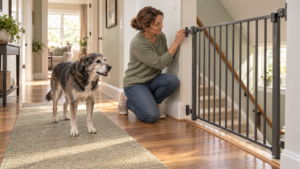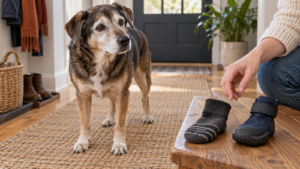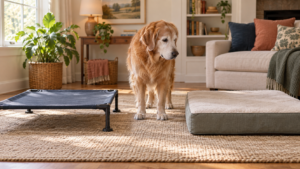

A supportive bed for a senior dog should make resting easier, not create one more obstacle. A bed can feel wonderfully soft to your hand and still be too tall, too slippery, too small, or too difficult to wash for the dog who will use it.
Start with the way your dog lies down, turns, and gets back up. Then check the bed’s usable sleeping area, entry height, stability, and care instructions. Those details tell you more than an “orthopedic” label by itself.
This guide explains how to choose a supportive bed for a senior dog without assuming that one material or style works for every older dog.
The short answer: check five things before you buy
- Sleeping footprint: Measure your dog in the position they actually use, not just from nose to tail while standing.
- Entry height: Count the full height your dog must step onto, including a raised edge or bolster.
- Stability: Check whether the bed and the floor beneath it stay put while your dog steps, turns, and rises.
- Care instructions: Find out which parts are removable, machine washable, and safe to dry.
- Fluid protection: Confirm whether the cover, liner, seams, and zipper are actually waterproof or only described as water resistant.
After those checks, compare surface feel, edge style, chewing risk, room size, and where the bed will live.
Watch your dog use the current bed first
Before measuring anything, watch one ordinary rest cycle. Notice the approach, the turn before lying down, and the first few steps after getting up.
- Does your dog pause before stepping onto the bed?
- Do they circle because they are settling, or because the usable space is cramped?
- Do their paws slip while they lower themselves or push up?
- Do they choose the floor beside the bed instead?
- Do they avoid a raised edge they used to step over easily?
These observations help you identify a shopping problem. They do not diagnose pain or arthritis. Cornell’s canine osteoarthritis guidance lists stiffness, changes in gait, reduced activity, trouble with stairs or jumping, and difficulty getting up from lying down among signs that deserve veterinary assessment. If getting up has become newly difficult, your dog seems painful, or their movement has changed, contact your veterinarian rather than trying to solve the whole problem with a new bed.
Measure the sleeping footprint, not the old bed
Bed sizes are not consistent across brands. “Large” can describe very different sleeping areas, especially when bolsters or sloped sides take up part of the outside dimensions.
Wait until your dog is resting in a favorite position. Measure the length and width of the space their body uses, then allow room to turn and change position. If your dog sleeps both curled and stretched out, use the larger footprint.
Compare that measurement with the bed’s usable sleeping surface rather than the outside dimensions alone. A 40-inch bed with thick bolsters may give your dog less room than a flat bed with the same listed length.
Treat bed thickness as a step height
A thick bed is not automatically easier for a senior dog. Your dog still has to step onto it.
Measure from the floor to the point where your dog enters. Include any frame, foam base, pillow top, or raised border. For a contour bed, check whether the low entry is wide enough for your dog’s normal approach.
Bolsters can give a dog an edge to lean against, but they also reduce sleeping space and may block an easy exit. A three-sided bolster with a broad low opening may work better than a raised edge on all four sides. Some dogs do better with a flat bed because they can approach it from any direction.
Check the floor under the bed
The bed and the route to it need to stay stable. A supportive foam core does not help much if the entire bed slides when your dog places one paw on the edge.
AAHA’s 2023 senior-care guidelines include environmental changes such as rugs or yoga mats for better footing and the use of appropriate beds. Cornell also includes non-slip rugs and ramps among lifestyle changes used in managing canine osteoarthritis. Those sources do not make a specific bed the right choice for your dog, but they support looking at the whole route instead of just the cushion.
- Place the bed on a dry, level surface.
- Test the bed by pressing down and sideways near the entry edge.
- Keep rug corners, cords, and loose protectors out of the approach path.
- Make sure an added non-slip layer does not curl into a new trip edge.
If the problem extends beyond the bed, our senior dog home safety guide covers traction routes, stair controls, lighting, and other household hazards.
Supportive does not simply mean soft
Very soft filling may feel cozy but compress deeply under a dog’s weight. A dog can then have more distance to push through while trying to stand. A very firm surface may be stable but not comfortable for the way that dog rests.
Instead of shopping by adjectives, look for usable specifications:
- Total bed height
- Foam or fill construction
- Whether the sleeping surface is flat, contoured, or tensioned
- Whether the edge collapses when stepped on
- Any dog-size or weight guidance supplied by the manufacturer
- The return policy if the bed is the wrong height or feel
The word “orthopedic” does not tell you those things. Treat it as a reason to read the construction details, not as proof that the bed will relieve pain or suit your dog’s movement.
Read the complete washing instructions
“Washable” may refer only to a removable cover. The foam core, bolster inserts, waterproof liner, or non-slip base may have different instructions.
Before buying, answer these questions:
- Does the outer cover come off without lifting or wrestling with the whole bed?
- Are the foam and bolster pieces clearly labeled so they can be reassembled?
- Will the cover fit in your washing machine?
- Can it go in the dryer, or must it air dry?
- Can you buy a replacement cover?
- How will your dog rest while the cover is being washed and dried?
A spare cover or thin washable protector can make accident cleanup easier, but keep every layer smooth. A bunched pad can make the surface uneven and can block a low entry.
Water resistant and waterproof are different claims
Water-resistant fabric may slow a small spill. It does not necessarily stop urine or another liquid from reaching the fill. Even a waterproof liner can have vulnerable seams, zipper openings, or uncovered sides.
Read which exact layer carries the claim. If accidents are likely, check how the liner closes, whether it can be wiped or washed, and whether moisture can become trapped around the foam. New urinary accidents or a sudden increase in accidents should be discussed with your veterinarian; bedding protects the room but does not explain why the change started.
Match the bed style to the job
| Bed style | May be useful when | Check before buying |
|---|---|---|
| Flat foam bed | Your dog needs a broad approach and room to stretch | Entry height, edge compression, cover removal, and floor grip |
| Bolster bed | Your dog likes leaning against an edge | Width of the opening and the sleeping space lost to bolsters |
| Contour or lounger bed | Your dog prefers a shaped surface without a separate frame | Slope, lowest entry point, and whether your dog can reposition easily |
| Elevated cot | You need airflow or a surface that keeps the dog off a damp floor | Frame height, tension, stability, and whether stepping up is comfortable |
| Travel pad | You need a familiar portable resting layer | Padding, packed size, washability, and whether it slides at the destination |
A bed style is not a treatment. If your veterinarian or rehabilitation professional has given you positioning, pressure-relief, or movement instructions, use those instructions to narrow the choice.
Plan the bedside setup
Leave enough clear floor space for your dog to approach, turn, and step away without backing into furniture. Put water within an easy route, but not where spills will make the entry slippery. At night, use steady lighting that lets your dog see the path without relying on a single small motion light.
Once the bed is in place, watch the first few uses. Check whether the bed shifts, the cover wrinkles, or your dog repeatedly chooses another surface. The goal is not to persuade your dog to use an expensive purchase. It is to learn whether the setup actually fits.
When a bed change is not enough
Call your veterinarian if your dog has new stiffness, trouble rising, a changed gait, reluctance to move, signs of pain, new accidents, skin sores, or a sudden change in sleeping behavior. AAHA notes that changes families interpret as normal aging can sometimes reflect chronic pain, and that those changes may be subtle.
A bed can improve the resting setup. It cannot diagnose arthritis, treat pain, prevent pressure injuries in a dog who cannot reposition, or replace a mobility and medical plan.
Use this final senior dog bed checklist
- I measured my dog’s largest normal sleeping position.
- I checked the usable sleeping area, not only the outside dimensions.
- I measured the lowest entry height.
- I tested how the bed and floor will resist sliding.
- I know which parts are removable, washable, and dryer safe.
- I checked the exact water-resistance or waterproof claim.
- I considered bolsters, chewing, room size, and the approach path.
- I know the return policy.
For researched examples across flat foam beds, contour beds, tougher covers, elevated cots, and travel pads, visit our Senior Dog Beds & Rest Products guide. We explain the documented specifications and limitations without claiming hands-on testing.
Editorial review and sources
This article was researched, editorially reviewed, and updated by the Well Walked Dog Editorial Team on July 16, 2026. It provides general educational information and is not a diagnosis or a substitute for veterinary care. We did not physically test the beds discussed in the linked product guide.
- 2023 AAHA Senior Care Guidelines for Dogs and Cats — pain, mobility, home modification, footing, and appropriate beds.
- Cornell Richard P. Riney Canine Health Center: Osteoarthritis — mobility signs, veterinary diagnosis, non-slip rugs, ramps, and multimodal management.