A dog car harness and an enclosed carrier solve the same basic problem in different ways: they keep a dog from riding loose. For a senior dog, the better choice also has to account for sore joints, balance, body size, breathing comfort, and how the dog gets into the vehicle.
A harness usually gives a medium or large dog more room to change position on the back seat. A secured carrier can give a small dog a contained resting space. Neither option is right simply because the label says “travel” or “crash tested.” Fit, installation, test method, and your dog’s comfort all matter.
Start with your dog, not the product label
Watch your dog get into the parked car before you buy a restraint. Stiffness, pain, a changed gait, reluctance to jump, and difficulty getting up can occur with osteoarthritis, according to Cornell’s canine osteoarthritis guidance. A restraint should not require a movement your dog can no longer make comfortably.
- Can your dog step into a carrier without crouching or twisting?
- Can you put on a harness without pulling a sore leg into an awkward position?
- Can your dog sit and lie down in the installed setup?
- Can you lift the carrier and dog together without tilting or dropping it?
- Does the restraint leave the dog clear of the front seat and airbags?
New pain, weakness, stumbling, breathing trouble, panic, or motion sickness calls for veterinary guidance before a long trip. A restraint manages movement in the car. It does not make an uncomfortable dog fit to travel.
The short answer: harness or carrier?
| Setup | May suit | Measure first | Main limitation |
|---|---|---|---|
| Vehicle restraint harness | A dog who is too large for a tested carrier and can sit or lie comfortably on the rear seat | Chest or girth, harness fit, seat-belt path, tether travel, and rear-seat space | Some harnesses are hard to put on over painful limbs; testing claims vary by model |
| Secured enclosed carrier | A small dog who settles in a contained space and fits within the exact tested size and weight limits | Dog’s standing and resting dimensions, carrier interior, door opening, vehicle seat, and combined lifting load | The dog may have too little room, overheat, panic, or be difficult for the caregiver to lift |
| Secured travel crate | A dog and vehicle with enough room for a properly sized, documented crate installation | Dog, crate interior, vehicle cargo area, door clearance, and anchor points | Many crates do not fit a normal rear seat, and a crate is not crash protection unless that exact model and size has supporting evidence |
The table is a starting point, not a safety rating. The exact product, size, and installation method determine what the setup can do.
When a car harness is the more practical choice
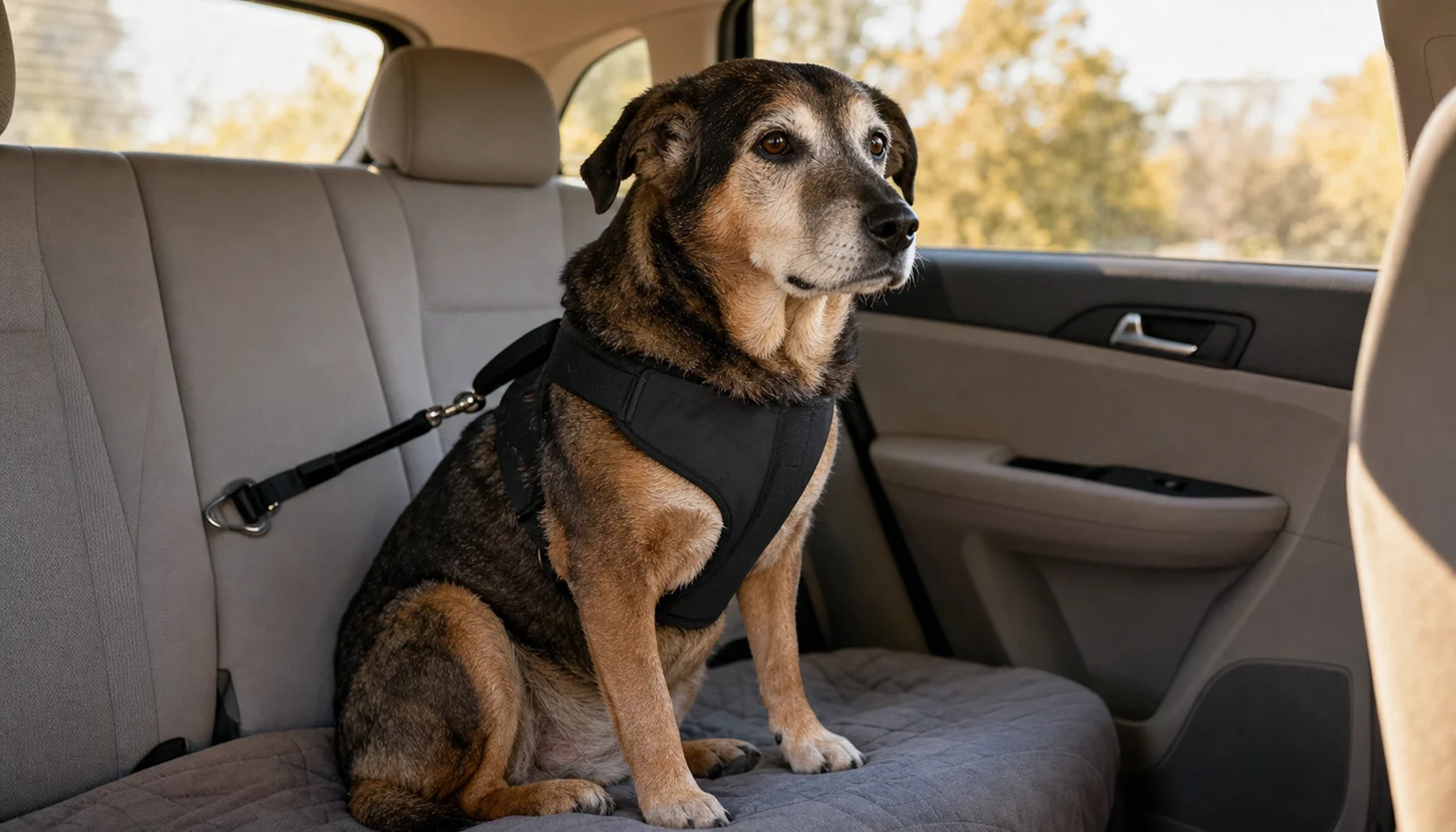
A vehicle restraint harness is often the workable option for a dog who cannot fit in a carrier. It may also suit a senior dog who becomes distressed in an enclosed space but can rest calmly on a protected rear seat.
Look for a harness designed for vehicle restraint, not an everyday walking harness with a generic tether clipped to it. Read the manufacturer’s installation instructions for the exact model. Check where the vehicle belt passes, how much forward and sideways movement the setup allows, and whether the dog can lie down without wrapping a strap around a leg.
A current example: Ruffwear Load Up
Ruffwear’s current Load Up Dog Car Harness attaches through a seat-belt loop and comes in five girth ranges, from 13 to 17 inches through 32 to 42 inches. The company says to measure around the widest part of the rib cage and choose the smaller size when the dog falls between sizes. Its care instructions call for hand washing with mild detergent and air drying.
The testing language needs a careful read. Ruffwear says prototypes were dynamically tested at an independent facility using conditions from the child-restraint standard FMVSS 213, with 25-, 45-, and 75-pound dog mannequins in a 30 mph frontal sled test. Ruffwear also states that the harness has not been tested to the Center for Pet Safety harness protocol and would not meet the current CPS excursion limit. In plain terms, “crash tested” and “CPS certified” are not interchangeable claims. The details are on Ruffwear’s testing and design page.
A harness may be a poor fit when
- Your dog cannot comfortably step through or tolerate the way the harness goes on.
- The chest panel presses into the throat, shoulder, armpit, or a sensitive lump.
- The dog cannot sit and lie down after the seat belt is routed correctly.
- The tether or belt can wrap around a leg.
- The only attachment point is a neck collar.
- The manufacturer does not explain how the restraint was tested or installed.
Do not loosen a harness until it slides freely just to make lying down easier. A loose fit can change how the dog moves inside the restraint. If the correct fit prevents a normal resting position, try a different model or another restraint type.
When an enclosed carrier may work better
A carrier can give a small senior dog a familiar place to settle. It may be especially useful for a dog who already sleeps in the carrier at home and becomes unsettled on an open seat. The carrier still needs to be secured exactly as directed. Setting it on the seat does not restrain it.
A current example: Sleepypod Mobile Pet Bed
The Sleepypod Mobile Pet Bed is an enclosed carrier and bed for pets up to 15 pounds. The manufacturer lists exterior carrier dimensions of 17 inches in diameter by 13.5 inches tall and interior dimensions of 15 inches in diameter by 11.5 inches tall. The exterior can be wiped with a damp cloth, and the removable interior plush is machine washable.
The Center for Pet Safety record says the one-size carrier passed its August 2024 test with a 15-pound test dog under protocol CPS-001-016.02. That evidence applies to this named product and tested load. It does not establish that another round carrier, a larger pet, or a different installation will perform the same way.
A carrier may be a poor fit when
- Your dog exceeds the stated weight limit or cannot rest inside without being curled tightly against the sides.
- Getting through the opening requires a painful crouch, jump, or twist.
- The dog pants heavily, claws at the enclosure, drools, or cannot settle during a parked-car trial.
- The carrier blocks ventilation once it is installed in the vehicle.
- You cannot safely lift and hold the combined weight of the dog and carrier.
- The carrier cannot be secured by the documented belt or anchor path in your vehicle.
Do not choose by weight alone. A long-backed or tall small dog may stay under the limit and still lack enough usable room. Measure the dog’s normal resting position and compare it with the interior, not the outside shell.
How to read crash and safety claims
Pet travel labels are easy to misread. “Vehicle restraint,” “crash tested,” and “independently certified” describe different levels of evidence. Before relying on a claim, look for five specifics:
- The exact product and size that was tested.
- The test protocol and speed or crash pulse.
- The test dog’s or mannequin’s weight.
- The required belt, tether, anchor, or vehicle position.
- Whether the result came from the manufacturer or an independent certification program.
The Center for Pet Safety certified-products directory publishes product-specific records. Use the record for the exact model rather than assuming every product from the same brand carries the same result.
Run a parked-car fit check
Install the restraint while the vehicle is parked in a cool, quiet place. Follow the product and vehicle manuals. Then check the setup without starting the trip.
- Help your dog enter by the normal route. Use the ramp, step, or lift support you plan to use away from home.
- Secure the harness, carrier, or crate exactly as instructed.
- Watch the dog stand, turn, sit, and lie down. Stop if a strap twists, the enclosure tips, or the dog loses footing.
- Check breathing, panting, drooling, vocalizing, and attempts to escape.
- Confirm that doors, buckles, and release points remain reachable.
- Repeat a short trial with the engine running before taking a brief local drive.
The American Veterinary Medical Association’s travel guidance recommends getting pets used to carriers, harnesses, and other restraints before a long trip. It also says dogs should be safely restrained, kept out of the front passenger seat when the car has airbags, and never allowed to ride on the driver’s lap.
Make the whole route senior-dog friendly
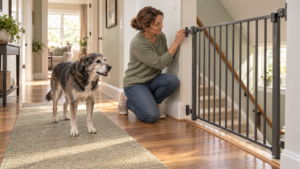
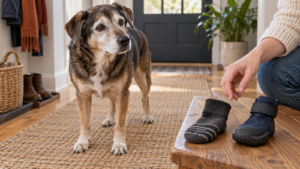
The restraint is only one part of the trip. A dog can be secure in the car and still struggle with the walk from the house, the step into the vehicle, a slick seat cover, or the exit at the destination.
- Keep a grippy path from the resting area to the vehicle.
- Use the same entry aid at both ends of the trip.
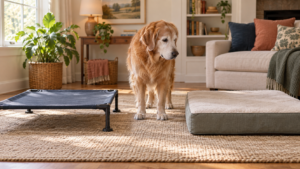
- Place a stable, nonslip surface under the dog or secured carrier where the product instructions allow it.
- Keep the cabin comfortably ventilated and never leave the dog unattended in the vehicle.
- Plan breaks around your dog’s normal medication, water, toileting, and rest needs.
- Recheck fit after weight change, coat change, worsening stiffness, or a new diagnosis.
For current examples of restraints, entry aids, seat protection, travel bowls, and rest setups, visit our Senior Dog Travel & Car Access Products guide.
How we researched this guide
We reviewed current manufacturer specifications, installation and care information, published test details, independent certification records, and veterinary travel guidance. We did not physically test these products. Product designs, instructions, certification status, and size ranges can change, so confirm the current product page and manual before buying or installing a restraint.
- Ruffwear: Load Up Dog Car Harness specifications, sizing, and care
- Ruffwear: Load Up testing and design details
- Sleepypod: Mobile Pet Bed specifications and care
- Center for Pet Safety: Sleepypod Mobile Pet Bed test record
- Center for Pet Safety: certified-products directory
- AVMA: traveling with your dog or cat
- Cornell: canine osteoarthritis
Shopping disclosure: This article contains no affiliate links. Well Walked Dog is not currently an Amazon Associate and earns nothing from the linked manufacturer pages.