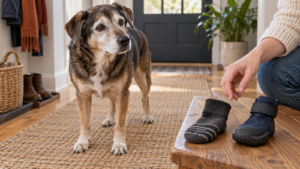
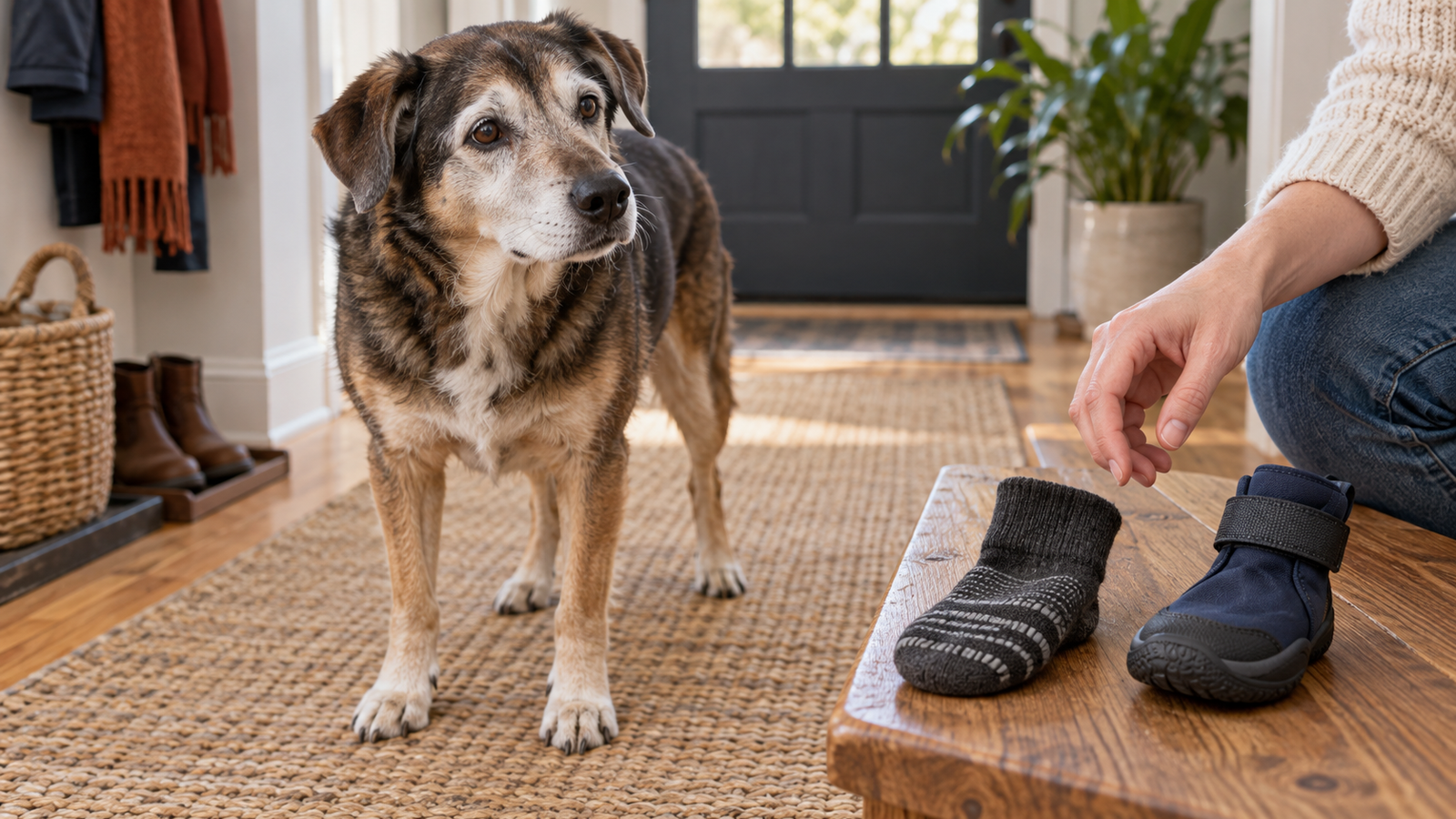
If your senior dog slips on smooth floors, traction socks and dog boots may look like two versions of the same idea. They are not. A soft grip sock is usually the more direct indoor option. A structured boot is built for more protection and a firmer sole, which can be useful on mixed indoor-outdoor routes but may ask more of a dog who already lifts, scuffs, or places a paw awkwardly.
Start with the route, not the product. If a secure rug runner can cover the places your dog uses every day, that is often the simpler first change. Paw wear becomes worth considering when the route cannot be covered well, your dog needs grip in several rooms, or the same outing also requires paw protection.
New slipping needs a health check, not just new gear. Call your veterinarian if the change is sudden or comes with pain, weakness, toe dragging, knuckling, falls, trouble getting up, or a changed gait. Cornell’s osteoarthritis guidance lists stiffness, gait changes, difficulty rising, and reluctance to walk among signs that warrant veterinary assessment. Socks and boots can change contact with the floor, but they do not diagnose or treat the reason a dog is slipping.
Quick answer: socks for indoor grip, boots for added protection
A traction sock may suit a senior dog who needs help on dry indoor flooring and tolerates light fabric around the paw. Look for grip that still contacts the floor if the sock shifts, a fastening system that does not press the dewclaw, and a fit that stays up without squeezing the leg.
A dog boot may suit a route that includes rough ground, hot or cold pavement, debris, or wet conditions as well as a slippery floor. The tradeoff is more material around the paw and a sole that may feel unfamiliar. A heavy or poorly fitted boot can also rotate, rub, or change how a dog places the foot.
Choose neither when the paw wear twists, bunches, traps moisture, causes redness, or makes the dog less steady. In that case, return to the route itself: stable runners, secure transitions, shorter paths, and veterinary or rehabilitation guidance.
| Question | Traction sock | Dog boot |
|---|---|---|
| Primary job | Add soft, flexible grip on a dry indoor surface | Add a grippy sole plus protection from the surface |
| What the dog feels | Fabric close to the paw, with less structure underfoot | A separate sole and more material around the paw |
| Best route to test | Short, predictable indoor path | Mixed route where protection is also needed |
| Main fit risk | Twisting, bunching, slipping down, or a tight strap | Rotation, rubbing, trapped debris, or an overly stiff sole |
| Care question | Can you keep the fabric clean, dry, and grippy? | Can you clean the sole and upper and dry the boot fully? |
First decide whether the floor or the paw needs the change
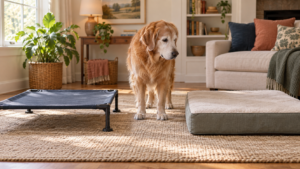
Watch one complete route your dog uses often: bed to water, living room to the potty door, or sleeping area to the yard. Notice where the paws first slide. A dog may be steady on a runner, hesitate at its edge, and then scramble on exposed flooring. That pattern points to a route problem more than a need for all-day paw wear.
Our senior dog home-safety route audit helps you check the whole path. If the main problem is a bare stretch of floor, use the rug-runner guide to compare backing, edge security, width, and cleanability.
Paw wear may still be useful when rugs would leave gaps at doorways, in a kitchen, or along several changing routes. It can also make sense for a dog who needs outdoor paw protection during the same trip. The point is to solve the smallest real problem. Covering a safe, fixed route does not require your dog to accept something on every paw.
When a traction sock may be the better indoor trial
A traction sock keeps the setup relatively light. That can matter for a dog who still places each paw normally but loses purchase on hardwood, laminate, or tile.
Current sock designs vary. For example, DOK says its TigerToes socks use grip around the sock rather than on only one face, plus an attached button-free strap. Those are manufacturer design claims, not proof that the socks will stay aligned or prevent a fall for every dog. The useful shopping lesson is broader: inspect how much of the sock remains grippy if it turns, how the fastener sits near the dewclaw, and whether the fabric can bunch between the toes.
A sock may fit when:
- The problem is limited to dry indoor flooring.
- Your dog lifts and places the paws normally but needs more surface grip.
- The sock remains flat and the grippy area stays under or around the paw.
- You can remove it regularly to check skin, nails, paw pads, and the space between the toes.
Skip or stop the sock trial when:
- The sock rolls, twists, slides down, or tightens around the leg.
- The strap lands on a dewclaw or a sensitive area.
- Your dog chews at it, freezes, high-steps, or becomes less stable.
- The paw is damp, irritated, swollen, wounded, or already needs veterinary care.
When a dog boot may be worth the extra structure
A boot is more than an indoor grip layer. A current Ruffwear Grip Trex boot, for example, has a textured outsole, breathable mesh upper, and a hook-and-loop closure. Ruffwear positions it for varied outdoor terrain and tells owners to recheck the closure and fit after the first 15 minutes of an activity and throughout the outing. The company also sells front and rear pairs because paw widths can differ.
That construction may be useful when a senior dog’s route includes abrasive ground, temperature extremes, or debris. It is not automatically better on a living-room floor. A thick sole may reduce the dog’s feel for the ground, and a dog who drags or knuckles a paw needs professional guidance rather than a tougher boot chosen by trial and error.
A boot may fit when:
- The dog needs paw protection as well as traction.
- The route moves between indoor flooring and a rough or weather-exposed surface.
- The sole bends enough for the dog’s movement and does not catch at floor transitions.
- The closure stays secure without pressing the dewclaw or restricting the leg.
Skip or stop the boot trial when:
- The boot rotates, flies off, or leaves a rubbed area.
- The sole catches on a rug edge or makes turning harder.
- The dog begins scuffing, crossing the legs, or placing a paw differently.
- Heat, moisture, or debris collects inside.
Measure every paw while your dog is standing
Do not choose a size from weight or breed alone. Both of the current manufacturer guides reviewed for this article tell owners to measure the paw at its widest point while it bears weight. Ruffwear also warns that front and rear paws can differ in width and says to measure all paws.
- Place one paw on paper while your dog stands naturally and safely.
- Mark the widest points that actually contact the floor.
- Measure between the marks.
- Repeat for every paw that will wear the product.
- Use that manufacturer’s current chart. Do not transfer a size label from one brand to another.
Width is only the first check. Compare sock height or boot cuff position with the dewclaw. Look at the closure path. Make sure seams and grip bands do not fold under the toes. If your dog cannot stand comfortably for measurement, ask your veterinary team or a canine rehabilitation professional for help rather than forcing the position.
Use a short, supervised route test
A living-room lap is more informative than watching a dog stand still. Choose a familiar route with room to stop. Keep the first trial brief and stay beside your dog.
- Start on secure footing. Put the sock or boot on while your dog stands or lies on a nonslip surface.
- Watch the first few steps. Look for normal paw placement, not merely forward movement.
- Include one gentle turn. Rotation often shows up when the dog changes direction.
- Check the transition. Make sure the sole or fabric does not catch where a runner meets the floor.
- Remove and inspect. Check the paw, toes, nails, dewclaw area, and leg for dampness, pressure marks, rubbing, or debris.
Stop immediately if your dog falls, cries out, panics, cannot place a paw, or becomes less coordinated. Contact your veterinarian promptly for a sudden change, inability to bear weight, repeated knuckling, or new weakness.
Fit and care matter more than the label
“Non-slip” on a package does not tell you whether a product will stay aligned on your dog’s paw. Nor does “breathable” mean the paw can remain covered indefinitely. Read the current instructions for fastening, washing, drying, and wear checks.
Ruffwear’s current Grip Trex care directions say to secure the fasteners, wash cold on a gentle cycle with mild detergent, and air dry. DOK describes TigerToes as an elastic cotton sock with rubber grip and a hook-and-loop strap, but its public product page does not provide the same clear washing block. Confirm care instructions with the maker before buying if you cannot find them on the current page.
Keep the gripping surface clean. Dust, hair, or moisture can change how it meets the floor. Replace damaged paw wear rather than tightening it to compensate for stretching or worn grip.
A practical order of decisions
- Rule out a new health or mobility problem with your veterinarian.
- Secure the daily route with stable runners where practical.
- If uncovered flooring remains, try the lightest option that matches the job.
- Choose a soft traction sock for indoor grip when it stays aligned and your dog accepts it.
- Choose a boot when the route also requires paw protection and the dog can move naturally in the sole.
- Recheck fit, skin, gait, and product condition every time.
For other mobility tasks, visit our Senior Dog Mobility & Support Products guide. If slipping is part of a broader problem with standing or assisted walking, the rear sling versus full-body harness guide explains how those tools divide the support job.
Editorial review and sources
This article compares product types using current manufacturer fit and care information plus veterinary guidance. Well Walked Dog did not hands-on test the products named as design examples. No affiliate links, prices, copied customer ratings, or review claims are included.
- Cornell University College of Veterinary Medicine: Osteoarthritis: signs, veterinary assessment, and nonslip home changes.
- DOK TigerToes Premium Non-Slip Dog Socks: current sock construction, weight-bearing measurement method, sizes, and manufacturer-stated uses.
- Ruffwear Grip Trex Dog Boots: current materials, closure, outsole, measurement method, fit-recheck guidance, and care.
- Ruffwear: Choosing the Right Dog Boots: current boot types, route-specific protection, and separate front/rear sizing context.
Sources reviewed September 22, 2026. Product specifications and instructions can change; check the current manufacturer page before choosing a size or care method.