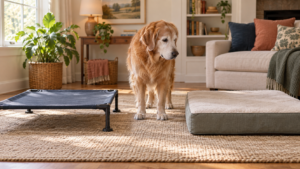
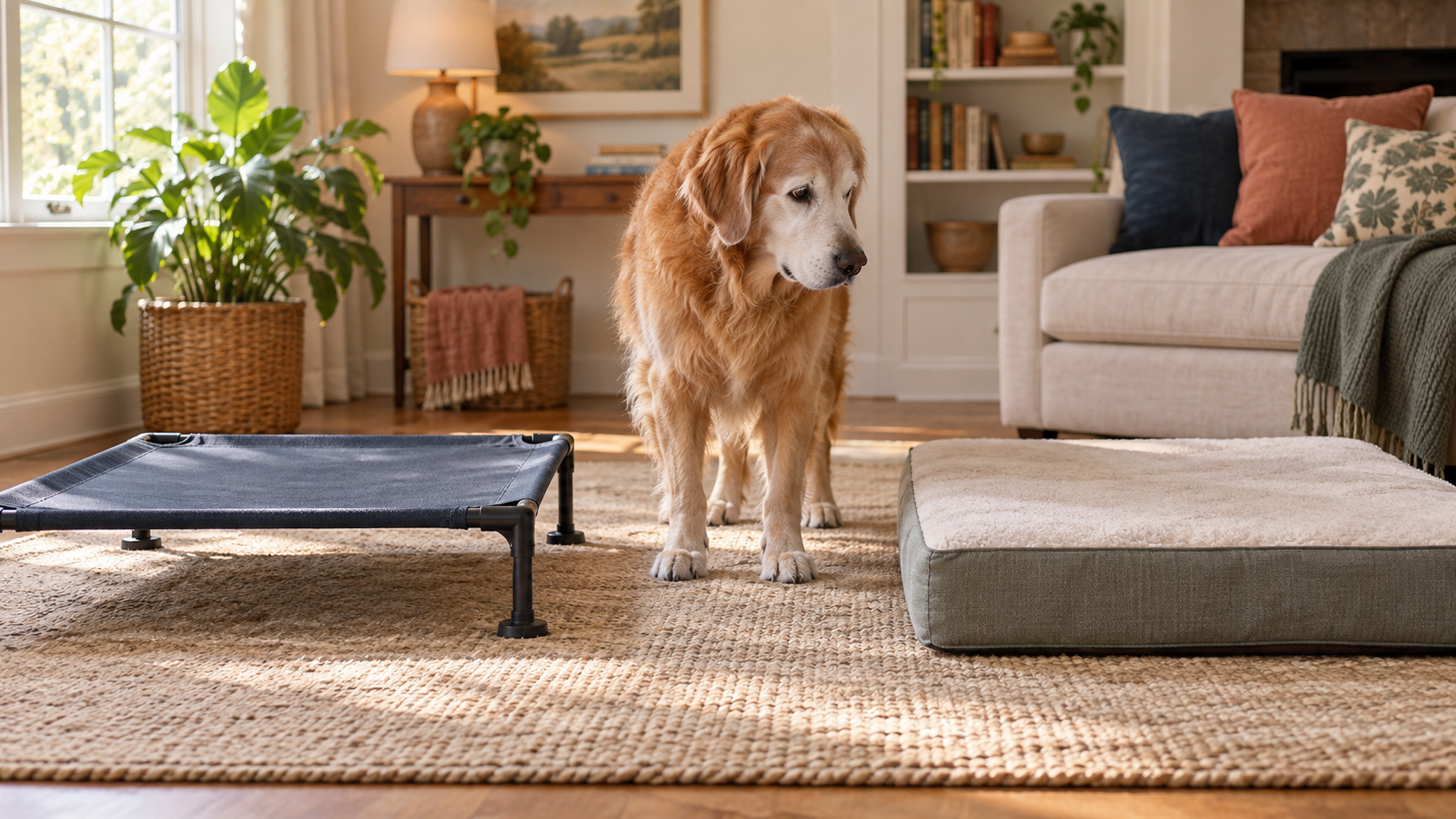
An elevated cot and a foam bed ask a senior dog to do different things. A cot adds a step and a taut surface. A foam bed may offer more cushioning, but its height, softness, or sliding cover can make entry and standing harder.
Do not choose from the label alone. Watch how your dog approaches a bed, lowers their body, changes position, and gets up. Then compare the complete setup: entry height, surface feel, frame or base stability, usable sleeping area, and cleaning needs.
The short answer
An elevated cot may suit a dog who comfortably steps onto a stable platform and prefers a firm, taut, airy surface. It can also make sense where frequent wipe-down or hose cleaning matters.
A foam bed may suit a dog who prefers a cushioned surface, needs a lower entry, or settles better on a surface that gives under the body. Foam beds vary widely, though. A thick mattress can create a bigger step, and a very soft edge can compress or shift under a paw.
Neither style is automatically better for arthritis or old age. A bed can improve the resting setup, but it does not diagnose or treat pain. New stiffness, a changed gait, trouble getting up, reluctance to move, or a sudden change in sleep deserves a veterinary conversation.
| Check | Elevated cot | Foam bed |
|---|---|---|
| Entry | Requires a step onto the frame and fabric | May be low or quite tall, depending on foam depth |
| Surface | Taut and tensioned | Compressible, with firmness that varies by construction |
| Airflow | Open space beneath the sleeping surface | Depends on foam, cover, room temperature, and floor |
| Stability | Frame and feet must stay planted | Base and cover must resist sliding or bunching |
| Cleaning | Some fabrics and frames can be wiped or hosed | Cover, liner, foam, and inserts may have separate care rules |
| Main limitation | The step and taut feel may not suit the dog | Height, heat, edge compression, and drying time may become problems |
Start with the step onto the bed
Measure from the floor to the point where your dog first places a paw. For a cot, that means the finished frame and fabric height, not the platform dimensions. For a foam bed, measure the edge before and after you press it with your hand. A soft edge may collapse, while a dense mattress may stay close to its listed height.
The current Kuranda Standard PVC bed page publishes several platform sizes and a rating for dogs up to 100 pounds, but it does not show a finished assembled height. That is a useful warning for any cot shopper: if the manufacturer does not publish the step height, ask before ordering. Do not estimate it from a product photo.
Foam is not automatically low. Big Barker’s current Original models use a 7-inch profile, while its Junior line uses a 4-inch profile for smaller dogs. Those examples are not rankings or medical recommendations. They show why the actual height matters more than the word “orthopedic.”
Compare a taut surface with a compressible one
A cot holds the dog on tensioned fabric. Some dogs like that steady, hammock-like feel. Others keep returning to a rug, carpet, or cushioned bed because they prefer more give. The dog’s usual choice is useful information, especially when it stays consistent across several days.
Foam construction changes how far the body sinks and how stable the edge feels. A bed that looks plush may make it harder for a dog to push up. A very firm bed may feel stable but still be rejected by a dog who avoids hard resting surfaces. Marketing terms do not settle that question. Check the foam depth, layer construction, dog-size guidance, and return terms.
Watch the whole movement, not only whether your dog lies down. Can your dog turn without stepping off? Does a front paw slide at the edge? Do they rock forward several times before standing? Do they choose the floor next to the bed instead? Those observations can guide a purchase, but they cannot tell you why movement changed.
Check what happens under the bed
A good sleeping surface can still fail if the bed moves. Push the cot sideways near each corner and check whether the feet grip the floor. Look for frame wobble, a bowed component, loose hardware, or fabric that was not installed according to the instructions.
With a foam bed, press down and sideways at the entry edge. The base should stay put, and the cover should not wrinkle into a loose ridge under the first paw. If you add a protector, keep it fitted and flat. A loose absorbent pad on top can bunch and create another unstable layer.
Cornell’s osteoarthritis guidance includes non-slip rugs and ramps among possible lifestyle changes within a broader veterinary plan. That supports checking the route and the bed together. If the path to the sleeping area is slick, fix that problem rather than expecting the mattress to compensate. Our rug runner guide for senior dogs who slip explains how to check route coverage, edges, transitions, and door clearance.
Match cleaning to the real household problem
An elevated cot can simplify cleaning because it has no foam core. Kuranda currently describes its PVC frame as suitable for indoor or outdoor use, lists replaceable components, and says its fabrics and beds can be washed or hosed with soap, water, or disinfectant. Fabric choice still matters. Its Breathable Mesh option is recommended by the manufacturer for incontinence, but that fabric is excluded from the chew-proof warranty.
A foam bed may have several separate care rules. “Machine washable” often applies to the cover, not the mattress. Big Barker currently describes removable, machine-washable covers on its Original line. That does not mean the foam can go in a washing machine. Before choosing any foam bed, check the cover, liner, foam, bolsters, zipper area, and drying instructions one by one.
- Can you remove the cover without lifting or wrestling with the whole bed?
- Does the mattress have a separate liner, and what does that liner protect?
- Can your washing machine hold the cover?
- How long will the cover or liner take to dry?
- Is a replacement cover available?
- Where will your dog rest while the bed is being cleaned?
If accidents have started recently or are becoming more frequent, bring that change to your veterinarian. A washable bed protects the room. It does not explain the change.
Who may prefer an elevated cot?
An elevated cot is worth considering when your dog already steps onto a similar-height stable surface without hesitation, prefers a firm resting place, gets warm on deep bedding, or needs a surface that can be cleaned frequently. It may also work in a damp-prone area when the exact materials are approved for that setting.
Pause if your dog drags a paw, catches toes on low edges, avoids small steps, needs a broad floor-level approach, or becomes unsteady when a surface moves. Confirm the frame’s current weight rating, assembled height, platform size, fabric limits, assembly steps, warranty, and return policy before buying.
Who may prefer a foam bed?
A foam bed may fit better when your dog seeks cushioning, avoids taut surfaces, or needs a floor-level mattress with several open approach directions. A lower foam profile can remove the frame step, but only if the edge stays stable when your dog puts weight on it.
Pause if the bed is so tall that your dog must hop onto it, so soft that standing becomes a struggle, or so warm that your dog repeatedly leaves it for the floor. Dogs that tear and swallow bedding need a separate chewing-safety discussion. A tough cover is not proof that exposed foam is safe to ingest.
Run a simple at-home check
- Measure the approach. Record the clear floor space and the bed’s lowest entry point.
- Test the base. Press down and sideways where the first paw will land.
- Watch one normal rest. Note the approach, turn, lying position, repositioning, and exit.
- Check the preferred surface. Pay attention to whether your dog consistently chooses taut, cushioned, cool, or familiar resting spots.
- Read every care label. Separate the instructions for fabric, cover, liner, foam, frame, and hardware.
- Keep the better option available. Do not remove a familiar usable bed until your dog has shown that the new setup works.
Do not coax a painful or fearful dog repeatedly onto a surface they avoid. If your dog cannot step onto the bed, slips during the test, cries, pants, trembles, or cannot rise comfortably, stop and ask your veterinary team what movement and bedding limits apply.
How this choice fits the rest of the bed plan
The cot-versus-foam decision is only one part of the setup. Use our supportive senior dog bed guide to check sleeping footprint, entry height, stability, washing, and fluid protection. If raised sides are the harder decision, read Bolster Bed or Flat Bed for a Senior Dog?
For current product examples with documented dimensions and limitations, visit the Senior Dog Beds & Rest Products guide. The guide includes foam, contour, elevated, and travel options. Well Walked Dog has not physically tested those products.
Editorial review and sources
This article was researched and reviewed by the Well Walked Dog Editorial Team on September 18, 2026. We compared current manufacturer specifications with veterinary guidance. We did not use customer-review text, product ratings, static prices, or hands-on testing claims.
- Cornell University College of Veterinary Medicine: Osteoarthritis for movement changes that warrant assessment and the role of non-slip surfaces in a broader management plan.
- Kuranda Standard PVC Dog Bed for current platform sizes, weight rating, frame and fabric choices, cleaning language, replacement components, and warranty limitations.
- Big Barker Original Orthopedic Dog Bed for current height, foam construction, cover care, size, configuration, and warranty details.
- Big Barker Junior Orthopedic Dog Bed for a current lower-profile foam example sized for smaller dogs.