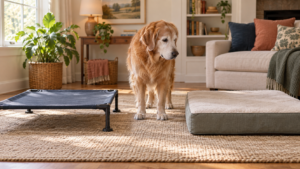
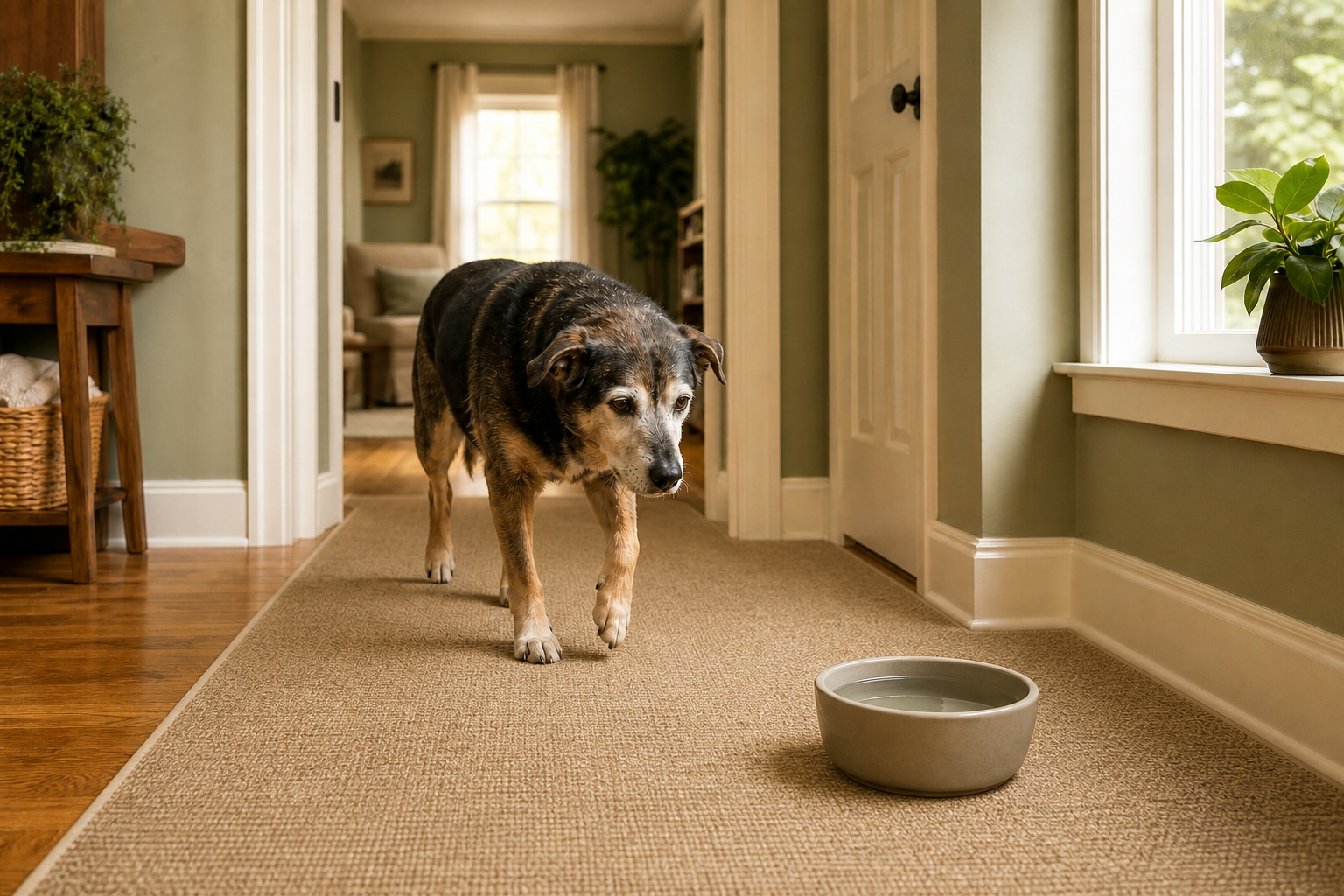
A rug runner can give a senior dog a steadier path across hardwood, tile, or laminate. But the runner has to cover the route your dog actually uses. A small rug in the middle of a hallway will not help much if your dog still has to launch from a slick floor, cross an uncovered doorway, or turn beside the water bowl with no traction.
Start with the route, not the rug. Watch your dog move from bed to water, food, the outside door, and favorite resting spots. Mark the places where they rise, turn, pause, or change direction. Those are often the spots that need stable footing most.
First, make sure a runner is the right next step
Slippery flooring can make walking, turning, and rising harder for dogs with osteoarthritis. VCA’s current osteoarthritis guidance includes area rugs with non-skid backing and other traction surfaces among possible home changes. It also puts those changes within a broader veterinary care plan.
A rug can improve the floor under your dog’s paws. It cannot explain a sudden change in movement. Contact your veterinarian if slipping starts suddenly or comes with pain, repeated falls, weakness, toe dragging, paw knuckling, circling, disorientation, or trouble getting up. If your dog already has a mobility diagnosis, ask whether the route and surface fit their current plan.
The quick checklist
| Check | What to look for | Common problem |
|---|---|---|
| Route coverage | A continuous path through starts, stops, turns, and doorways | Small slick gaps between separate rugs |
| Backing or pad | A complete system that stays flat on your exact floor | A cover used without its required pad |
| Edges | Low, flat perimeter with no curl or raised corner | A new trip point at the approach |
| Surface | Enough grip without a rough or unstable texture | Paws slide, catch, or sink during a turn |
| Clearance | Doors, gates, walkers, and people can pass safely | A door drags the runner into a wrinkle |
| Cleaning | A realistic wash-and-dry routine for the chosen size | The runner stays damp, dirty, or misaligned after washing |
Map the whole route before measuring
Follow your dog at the times when slipping is most likely. That may be after waking, while hurrying to the door, during a nighttime water trip, or when turning around in a narrow hall. A phone video can help you review the path later, but keep the first pass simple: note where each paw leaves the stable surface.
- Where does your dog first stand up?
- Which route leads to water, food, and the outside door?
- Where do they turn or pivot?
- Do they step sideways around furniture?
- Is there a threshold, floor vent, cord, or door swing in the path?
- Where do they stop before lying down again?
Do not assume the shortest line is the real line. Older dogs may take a wider turn, drift to one side, or approach a bowl at an angle. Measure the path they use comfortably, not the route you wish they would take.
Map more than the floor
Before measuring a runner, use the complete senior dog home-safety route audit to note starts, turns, thresholds, lighting, rest areas, and entry points. The free printable helps you keep the full route in one place.
Measure length, width, and every transition
Measure from one stable surface to the next. If the runner ends six inches before the water bowl or doorway, that uncovered strip may become the hardest part of the route. Include enough room for all four paws while your dog drinks, turns, waits at the door, or changes direction.
Width matters too. A narrow runner may work for straight walking but fail where a large dog pivots. Use painter’s tape to mark a proposed width on the floor, then watch the route for a day before ordering. Make sure the tape itself is secure and remove it if it lifts.
Check every transition between the runner and another surface. Two rugs placed end to end can separate over time. A runner that meets a thicker area rug can leave a lip. A gap at a doorway may put all four paws back on the slick floor just as your dog turns.
Backing is a system, not a label
Words such as “non-slip” or “non-skid” do not guarantee that a rug will stay put in every home. Floor finish, dust, moisture, pad alignment, the dog’s weight, and sideways force during a turn can all change how the setup behaves.
Read what the manufacturer requires. Some washable covers are designed to work only with a matching pad. For example, Ruggable’s current Kamran Coral Flatwoven page describes a two-piece system and says the standard or cushioned rug pad is required. Using only the cover would not be the documented setup.
- Confirm that the cover and pad are sold together or add the required pad.
- Check whether the pad can be used on your floor type and finish.
- Make sure the pad reaches the working perimeter rather than leaving loose fabric beyond it.
- Press and push at every corner before your dog uses the route.
- Recheck after vacuuming, washing, or moving furniture.
Do not improvise with a loose towel, blanket, or bath mat in a walking lane. A soft item can bunch under a paw or slide as the dog turns. If you add a separate rug pad or tape, follow both the rug maker’s and flooring maker’s instructions. Some materials or adhesives may not suit every finish.
Keep the edges low and predictable
A thick, plush runner may feel comfortable under a hand but still be difficult for a dog who shuffles, scuffs a paw, or has limited joint movement. Compare the complete cover-and-pad thickness, not just the cover. Look closely at binding, corners, and the direction your dog approaches.
Door clearance is easy to miss. Open each door fully over the marked route. If the bottom of the door catches the runner, it may push the rug into a ridge. Also check that the runner does not block a floor vent, interfere with a gate, or narrow the safe path for people carrying laundry or helping the dog.
Choose a surface your dog can use
The top surface needs enough grip for walking and turning, but more texture is not automatically better. Deep pile can catch nails or make paws sink. A hard raised texture may be uncomfortable. A very smooth weave may still feel slick to a dog with weak rear legs.
If possible, test a small sample or one returnable section under close supervision. Watch the paws, not just the dog’s willingness to cross. Look for backward sliding, toes spreading for grip, shortened steps, hesitation at the edge, or a hurried exit. Stop if the route looks harder rather than easier.
Nail and paw care can affect traction too. VCA advises keeping nails short for dogs with osteoarthritis. Ask your veterinarian or groomer for help if your dog cannot stand comfortably for nail care or if trimming at home is unsafe.
Plan for real cleaning
A washable runner is useful only if the chosen size fits your cleaning routine. Check washer capacity, whether the cover separates from the pad, allowed detergent, drying instructions, and how long the route will be unavailable.
The current Ruggable product page lists 2.5-by-7, 2.5-by-10, and 2.5-by-12-foot runner sizes for its Kamran design. It describes a 2 millimeter flatwoven polyester cover with a waterproof barrier. The page instructs owners to wash the cover separately in cold water with mild, non-bleach detergent, then use air-fluff drying or lay it flat to air-dry. Those details are useful, but a 12-foot cover still has to fit your washer and be reattached flat.
For accidents or spills, remove moisture promptly and clean both the top and anything underneath according to the maker’s instructions. A waterproof layer can protect the floor below, but it does not keep the walking surface dry. Keep a second safe route available while the main runner is being cleaned.
Test the setup before relying on it
- Clear clutter, cords, and loose mats from the route.
- Place the complete runner and pad system exactly as directed.
- Press every edge and corner, then push sideways at turning points.
- Open doors and gates through their full movement.
- Walk the route yourself and check for wrinkles, rocking, and hidden edges.
- Let your dog approach without pulling or pushing.
- Supervise several starts, stops, and turns in both directions.
- Inspect the setup again after the first day and after every cleaning.
A stable runner should make the familiar route easier to use without demanding a new movement pattern. If your dog avoids it, walks along the exposed floor beside it, or slips at the ends, change the placement rather than trying to coax them across.
Build the route one problem at a time
A runner addresses footing. It does not replace lighting, stair barriers, a ramp, help rising, or veterinary care. Start with the most-used route and fix the obvious gaps. Then watch how your dog moves before adding more products.
Our Senior Dog Home Safety & Daily Living Products guide compares current options for traction paths, stair access, nighttime lighting, spill protection, and observation. If slipping is part of a broader change that includes pacing or nighttime waking, read how to help a senior dog who slips, paces, or wakes at night.
Sources reviewed
- VCA Animal Hospitals: Helping Your Dog with Osteoarthritis, last updated June 19, 2026.
- Ruggable: Kamran Coral Flatwoven Rug specifications and care, checked July 31, 2026.
Well Walked Dog uses current veterinary guidance and manufacturer specifications to explain selection factors. We did not perform hands-on testing of the products named as examples. Product construction, sizes, care instructions, and compatibility can change; confirm the current manufacturer information before ordering or placing a runner.