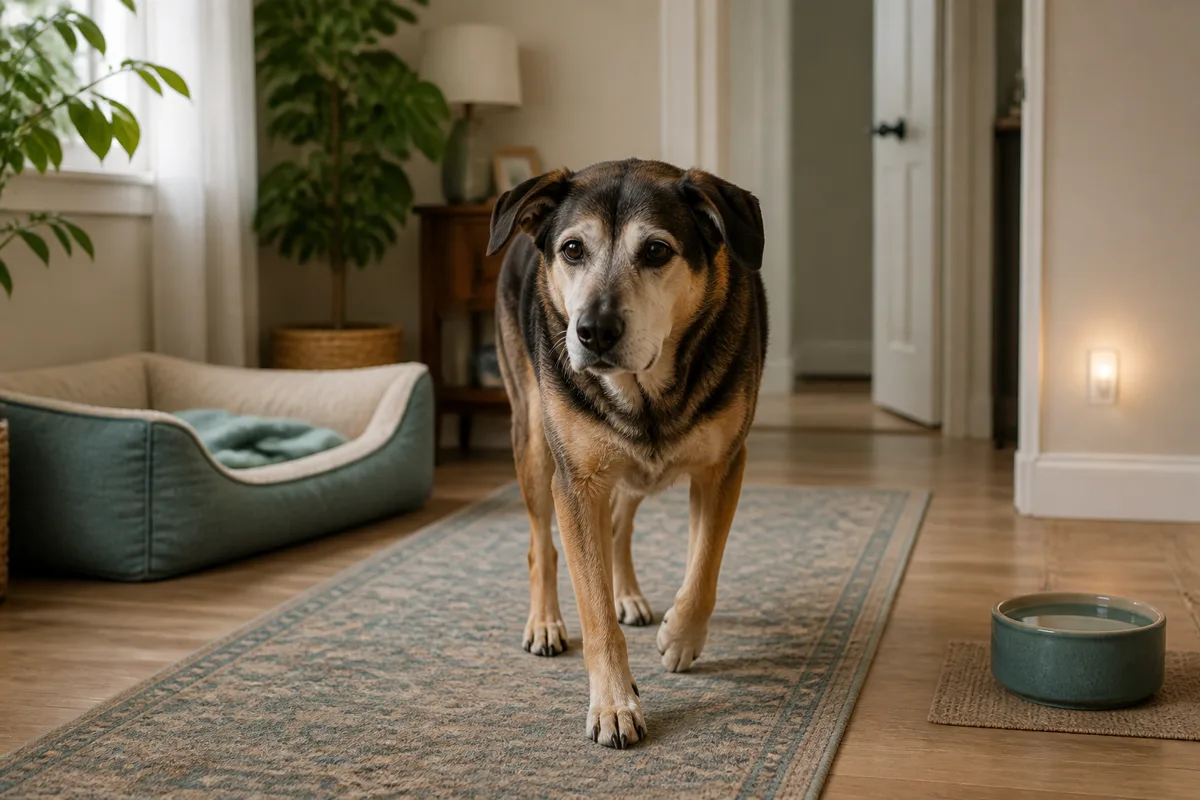
A bed, bowl, or ramp can be suitable on its own while the route leading to it is still difficult. The slick turn beside the water bowl, the single step outside the potty door, or the dark gap between two runners may matter more than another product.
A practical senior dog home-safety check starts by following the routes your dog actually uses. Watch the whole trip: getting up, turning, crossing thresholds, stopping, and settling again. This is a Well Walked Dog observation framework, not a veterinary test.
First, separate a home obstacle from a new health change
A safer setup may support an older dog’s comfort and confidence, but it cannot explain a new mobility or behavior change.
Contact your veterinarian promptly about sudden or worsening weakness, repeated falls, pain, disorientation, new accidents, or difficulty managing a familiar route. The American Veterinary Medical Association notes that changes such as avoiding stairs, jumping, or getting into cars can have an underlying cause. Do not dismiss a clear change as “just aging.”
If you are unsure whether a change can wait, call your veterinary clinic and describe what you are seeing. For a broader decision guide, read Normal Aging or a Vet Visit?.
Trace four routes your dog uses every day
Choose a normal time of day and watch without rushing your dog. Start with four common routes:
- Bed or favorite resting place to food and water
- Bed to the potty door or established indoor potty area
- Family area to a quiet resting place
- Front door to the porch, driveway, and parked car
At each route, notice the first push up from rest, turns, slick gaps, thresholds, narrow passages, steps, and whether anything shifts underfoot. Watch for hesitation, rushing, slipping, or abandoning the trip.
A short phone video can also help you remember what happened. The 2023 AAHA Senior Care Guidelines note that photos or videos of a pet moving in the home environment can be useful during veterinary assessment.
Check seven high-friction zones
Floors and pathways
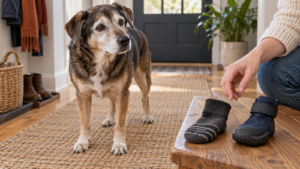
Look for continuous, stable footing—not only a rug at the destination. Pay attention to starts, turns, doorways, and the gaps between runners. AAHA’s senior-care guidance includes secure rugs, carpet runners, and yoga mats as possible ways to improve footing.
A loose mat can become a new obstacle. Check that edges lie flat and that the surface does not slide when your dog pushes off or turns. If flooring is the main problem, choose a runner that covers the complete route.
Stairs and level changes
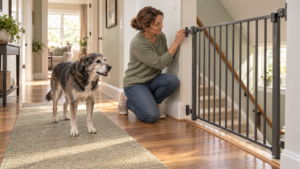
Count every level change, including a single doorstep, curb, sunken room, or awkward threshold. Consider whether access should be blocked, relocated, or adapted rather than assuming your dog needs to keep using it.
AAHA and Cornell veterinary guidance both identify stairs as a possible hazard for some senior dogs. If equipment may help, measure before choosing a ramp or steps and ask your veterinarian or rehabilitation professional about dog-specific needs.
Rest areas
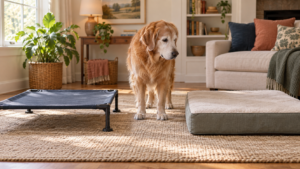
Check how your dog reaches the bed, steps into it, turns, and gets back up. Look at entry height, padding, stability, and whether the bed is close to normal family activity and the potty route.
An accessible rest area may mean moving a familiar bed rather than buying another one. AVMA senior-pet guidance gives new sleeping areas that avoid stairs as one example of adapting the home. If the bed itself is the concern, review entry height, stability, and usable sleeping space.
Food, water, and potty routes
Check the entire trip, not only bowl height. Is there secure footing at the turn? Can your dog stop comfortably? Is the potty door easy to approach and clear?
Keep essential locations predictable when familiarity matters. Cornell’s senior-dog guidance recommends consistency in the locations of beds, furniture, food, and water, and says an existing indoor potty setup should be easy to enter and exit. That guidance is discussed in the context of canine cognitive dysfunction; nighttime movement or an accident by itself does not diagnose dementia.
Nighttime movement
Walk the same route after dark. Look for deep shadows, dark turns, stairs, reflective glare, and places where your dog could become stuck. Low-level lighting may help along an established route, while familiar furniture and destinations should remain predictable.
New nighttime wandering, disorientation, or house-soiling deserves veterinary discussion. When slipping and nighttime waking are already happening together, use our step-by-step guide to building one safer route first.
Entry and car access
Include the front step, porch, curb, driveway surface, parking clearance, and the movement required to enter the vehicle. A ramp can fit the car and still leave an unstable approach or landing.
New avoidance of steps or the car can reflect an underlying problem, so mention it to your veterinarian. Once you understand the complete route, you can choose a restraint for the way your dog actually enters and rides or compare car-access equipment.
Caregiver handling
Notice any point where the setup requires last-second catching, awkward lifting, or leaning over an unstable surface. A professionally fitted mobility harness or sling may be useful for some dogs, but it is not a universal fix. Ask for hands-on guidance if you are unsure how to support your dog safely.
The University of Illinois veterinary handout on senior-dog concerns and solutions lists non-slip surfaces, supportive beds, ramps, steps, and sling-type harnesses among possible options while emphasizing veterinary evaluation when an older dog is slow to rise or has difficult first steps.
Choose three first changes—not everything at once
A whole-house list can become overwhelming. Start with the spots that are:
- Used several times each day
- Places where difficulty is repeatedly visible
- Connected to an essential need such as water, rest, or toileting
- Fixable with a low-risk, reversible change
That might mean securing the slick turn beside the water bowl, moving a rest area closer to the potty door, blocking an unsafe stairway, or adding light along an established nighttime route.
Change one or a few variables at a time. This makes it easier to see whether the route becomes simpler or whether the difficulty persists.
Rewalk the route
After making a change, watch your dog use the route naturally. Confirm that a mat, gate, light, bed, or piece of equipment has not introduced a new obstacle. Record what helped and what still causes hesitation.
If difficulty persists, worsens, or seems unrelated to the environment, contact your veterinarian. Bring notes, photos, or video when they can show what happens at home.
Download the free home-safety walk-through
The Senior Dog Home Safety Walk-Through is a five-page, low-ink printable that helps you:
- Check movement, access, rest, food, water, and potty routes
- Review nighttime, entry-point, and car-access concerns
- Record what is already working
- Choose the first three changes to make
Download the free Senior Dog Home Safety Walk-Through.
After the audit, browse our senior dog home-safety product guide only for the problem spots you have actually identified.
Editorial review and sources
This article was editorially reviewed and updated on August 11, 2026. It provides general educational information and does not replace veterinary advice, diagnosis, or treatment.
- American Animal Hospital Association: 2023 Senior Care Guidelines for Dogs and Cats
- American Veterinary Medical Association: Caring for senior cats and dogs
- Cornell University College of Veterinary Medicine: Senior dog dementia
- University of Illinois College of Veterinary Medicine: Senior Dogs—Special Concerns & Solutions