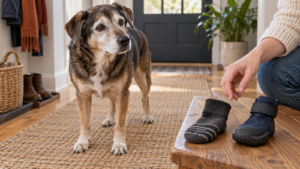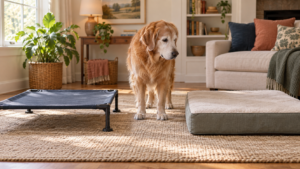
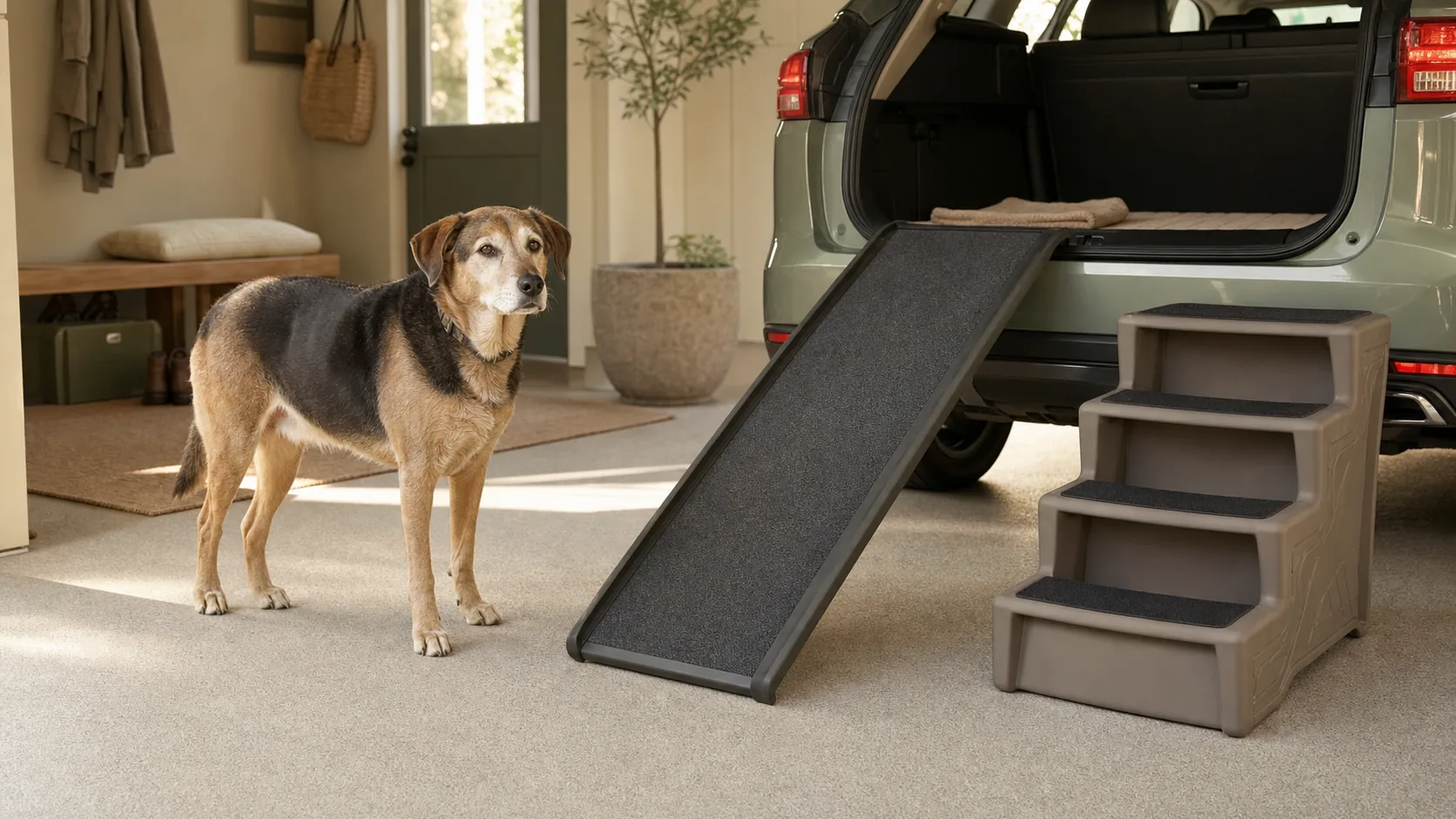
A dog ramp and pet steps can both reduce jumping, but they ask a senior dog to move in different ways. A ramp replaces the jump with a slope. Steps replace it with several smaller climbs. The better choice depends on your dog’s balance, joint movement, vision, confidence, and the space around the bed, sofa, or vehicle.
Measure the destination before comparing products. Then watch how your dog handles a low step, a gradual incline, turns, and changes in footing. A compact set of steps is not useful if each tread is too shallow. A long ramp is not useful if the room or parking space cannot hold it securely.
First, make sure this is an equipment problem
New hesitation at stairs, trouble rising, toe dragging, stumbling, weakness, or a changed gait can reflect pain or another health problem. The AAHA Senior Care Guidelines warn that chronic pain changes are sometimes mistaken for normal aging. AAHA includes ramps, better footing, fitted harnesses, and other home changes within a broader pain and mobility plan, not as substitutes for veterinary assessment.
Contact your veterinarian before asking your dog to learn new equipment if the change was sudden, your dog cries out, cannot bear weight, falls, knuckles a paw, seems disoriented, or cannot manage a route they handled recently. A veterinarian or rehabilitation professional can also help decide whether a slope or repeated steps fit your dog’s condition and recovery plan.
The short answer: ramp or steps?
| Option | May suit | Measure first | Main limitation |
|---|---|---|---|
| Ramp | A dog who benefits from a continuous path and can walk a stable slope without slipping or rushing | Vertical rise, usable ramp length, landing space, width, traction, and how the top attaches | A short ramp can become steep; a long ramp needs more floor or parking space |
| Pet steps | A dog who still places each paw accurately and can climb repeated steps with control | Total rise, number of steps, individual tread height and depth, width, top-step position, and base stability | Repeated lifting and lowering may be difficult for a dog with pain, weakness, poor balance, or limited vision |
| Neither yet | A dog with a new mobility change, repeated falls, marked fear, or no safe route around the equipment | The dog’s movement and the destination with veterinary or rehabilitation guidance | Buying equipment before identifying the problem may add another obstacle |
This is a movement comparison, not a universal ranking. Some dogs use steps well beside a low sofa but need a ramp for a vehicle. Others prefer a familiar step pattern and become uneasy on an incline. The answer can change as mobility changes.
Measure the vertical rise
Measure straight up from the floor or ground to the surface your dog must reach. For a vehicle, measure to the actual cargo floor or seat entry point, not just the bumper. For a bed or sofa, include any frame edge your dog must clear.
Take the measurement where the equipment will sit. A sloped driveway, curb, thick rug, or uneven threshold can change the setup. If you use the same ramp at home and in the car, measure both destinations. One length may create a manageable incline in one place and a much steeper one in another.
Measure the available run and landing space
A ramp trades compactness for a longer path. Measure the clear distance from the destination to the point where the lower end would rest. Leave room for your dog to approach straight, place all four paws on level ground, and step off without immediately turning into a wall, door, or parked car.
Manufacturer dimensions show why this matters. PetSafe lists its Happy Ride telescoping ramp as extending from 99 to 183 centimeters, about 39 to 72 inches. Pet Gear lists its Extra-Wide Free-Standing Ramp at 55 inches long, 19.25 inches wide, and 23 inches high. These are two different designs, but both take considerably more ground space than compact pet steps.
Steps need less forward space, but the top tread has to meet the destination closely enough that the dog does not face one final large jump. PetSafe lists its 20-inch CozyUp steps at 24 inches long and its 25-inch version at 28 inches long. That smaller footprint is useful only if the tread pattern and final transition fit your dog.
For steps, measure each tread
Total height does not tell you how the steps feel under a dog’s feet. Count the rises and measure the vertical distance between one tread and the next. Then measure the usable depth and width of each tread. Thick sidewalls, rounded fronts, or a narrow top platform can reduce the space shown in the outside dimensions.
- Can your dog place a full paw on the tread without hanging over the edge?
- Is there enough depth to pause and shift weight before the next step?
- Can your dog descend without skipping a tread or jumping from the middle?
- Does the top tread leave a gap, lip, or oversized final step?
- Can the dog approach and leave in a straight line?
A load limit does not answer those questions. PetSafe currently lists different load limits for its 20-inch and 25-inch CozyUp steps, but a product can support a dog’s weight and still be the wrong shape for that dog’s stride, body length, balance, or vision.
For ramps, check usable width and slope
Compare your dog’s body width and natural walking path with the usable surface between the side edges. A dog who drifts sideways, turns around, or needs support from a harness may need more room than a dog who walks a straight line. Raised edges can help define the path, but they do not prevent a fall if the ramp is too narrow or unstable.
Do not assume one ramp angle is safe for every senior dog. The usable incline depends on the rise, ramp length, surface, and the dog’s movement. A longer extension usually creates a gentler slope at the same destination height, but it also requires more space. Follow the exact manufacturer’s placement instructions and stop if your dog scrambles, slides backward, rushes down, or tries to jump off the side.
Traction and stability matter on both
AAHA recommends home modifications such as rugs or yoga mats for better footing when appropriate. That same idea applies to the route around a ramp or steps. A textured tread does little good if the base slides across tile, the dog launches from a slick floor, or the landing surface moves underfoot.
- Press on every corner before use. The equipment should not rock, bow, fold, or shift.
- Check that rubber feet or grippers make full contact with the floor.
- Secure a vehicle ramp at the top exactly as instructed. Do not balance it loosely on trim that can flex or move.
- Keep the approach and landing dry, clear, and well lit.
- Inspect fabric, carpet, or textured coating for wear that reduces grip.
- Recheck the setup after moving or storing it.
Manufacturer features are useful to verify, not guarantees of fit. PetSafe describes traction tread and side rails on its telescoping ramp. Pet Gear lists a slip-resistant surface, raised edges, and rubberized bottom grippers on its free-standing ramp. Your floor, destination, dog, and setup still determine whether those features work as intended.
Choose for the destination
Bed or sofa
Indoor steps can fit where a long ramp cannot, especially beside a low sofa. Check that they do not block a walkway or create a nighttime trip hazard. If your dog approaches from several directions, use furniture placement or a barrier to create one clear route rather than leaving an exposed side.
A ramp may be easier to understand if your dog struggles with repeated lifting, but only when there is enough room for a manageable slope and a straight approach. Put traction under the lower end if the manufacturer allows it, and keep the top transition flush and stable.
Vehicle
Vehicle height changes the ramp calculation. Measure the parked vehicle on the surface where you normally load. Confirm that the ramp fits the intended door or cargo opening, attaches to a structurally suitable point, and leaves enough room behind the vehicle to deploy it safely.
Steps can be compact, but they must be designed and positioned for the vehicle height. A household stair set that stops below the cargo sill may leave a difficult final climb. It can also shift on pavement if its feet were designed for indoor flooring. Do not improvise with stools, loose boards, boxes, or stacked household items.
Check the approach as well as the equipment
Use the senior dog home-safety route audit to review the front step, porch, curb, driveway surface, parking clearance, landing, and doorway as one route. The included free printable helps you record problems before choosing a ramp or steps.
Introduce the equipment before you need it
Set the ramp flat on the floor first, or let your dog investigate the steps in a quiet room. Reward a look, a sniff, or one voluntary paw. Keep sessions short. Do not pull the dog up by the collar or push from behind.
When your dog is comfortable, set the equipment at the lowest practical destination and supervise each pass. A well-fitted support harness may help some dogs, but use it for balance rather than dragging or lifting unless your veterinarian or rehabilitation professional has shown you how.
Practice both directions. Going down may be harder because the dog must control forward momentum and see the next surface. Stop while your dog is still calm rather than repeating the route until they are tired.
Stop and reassess if you see these signs
- Freezing, crouching, or repeated refusal after a calm introduction.
- Scrambling, sliding backward, or rushing to escape the equipment.
- Skipping steps, jumping from the middle, or stepping off the side.
- Toe scuffing, paw knuckling, crossing the legs, or loss of balance.
- Heavy panting, trembling, crying out, or a marked change in posture.
- More stiffness or soreness after practice.
Fear can come from unfamiliarity, but it can also reflect pain, poor vision, weakness, or a setup that simply does not fit. Do not keep increasing treats to persuade a dog through visible difficulty. Change the setup and ask your veterinarian for guidance when the movement itself looks hard.
A practical measuring checklist
- Measure the vertical rise to the exact bed, sofa, seat, or cargo floor.
- Measure clear floor or ground space for the full ramp or step footprint.
- Leave a straight, level approach and landing area.
- Measure usable width between side edges.
- For steps, record each tread’s rise, depth, and width.
- For a ramp, compare the usable length at that destination and follow the manufacturer’s placement limits.
- Confirm the product’s load limit, including any size-specific limit.
- Check traction at the tread, base, approach, and landing.
- Confirm how the top attaches and whether the setup can rock, fold, or slide.
- Plan where the equipment will stay or how you will store and redeploy it consistently.
Bring these numbers to our Senior Dog Mobility & Support Products guide, where we compare current ramp, step, sling, and full-body support options by task and published specifications. If slipping is part of a wider nighttime pattern, our guide to slipping, pacing, and waking at night can help you separate immediate home changes from signs to discuss with your veterinarian.
Sources reviewed
- American Animal Hospital Association: Supporting Your Senior Pet, published October 1, 2024.
- 2023 AAHA Senior Care Guidelines: Pain Management.
- PetSafe: How to Use Your Telescoping Ramp.
- PetSafe Happy Ride Telescoping Dog Ramp specifications.
- PetSafe CozyUp Folding Pet Steps specifications.
- Pet Gear Extra-Wide Free-Standing Pet Ramp specifications.
Well Walked Dog uses current veterinary guidance and manufacturer specifications to explain selection factors. We did not perform hands-on testing of the products named as measurement examples. Product details can change; confirm the current model, dimensions, load limit, and instructions before use.