
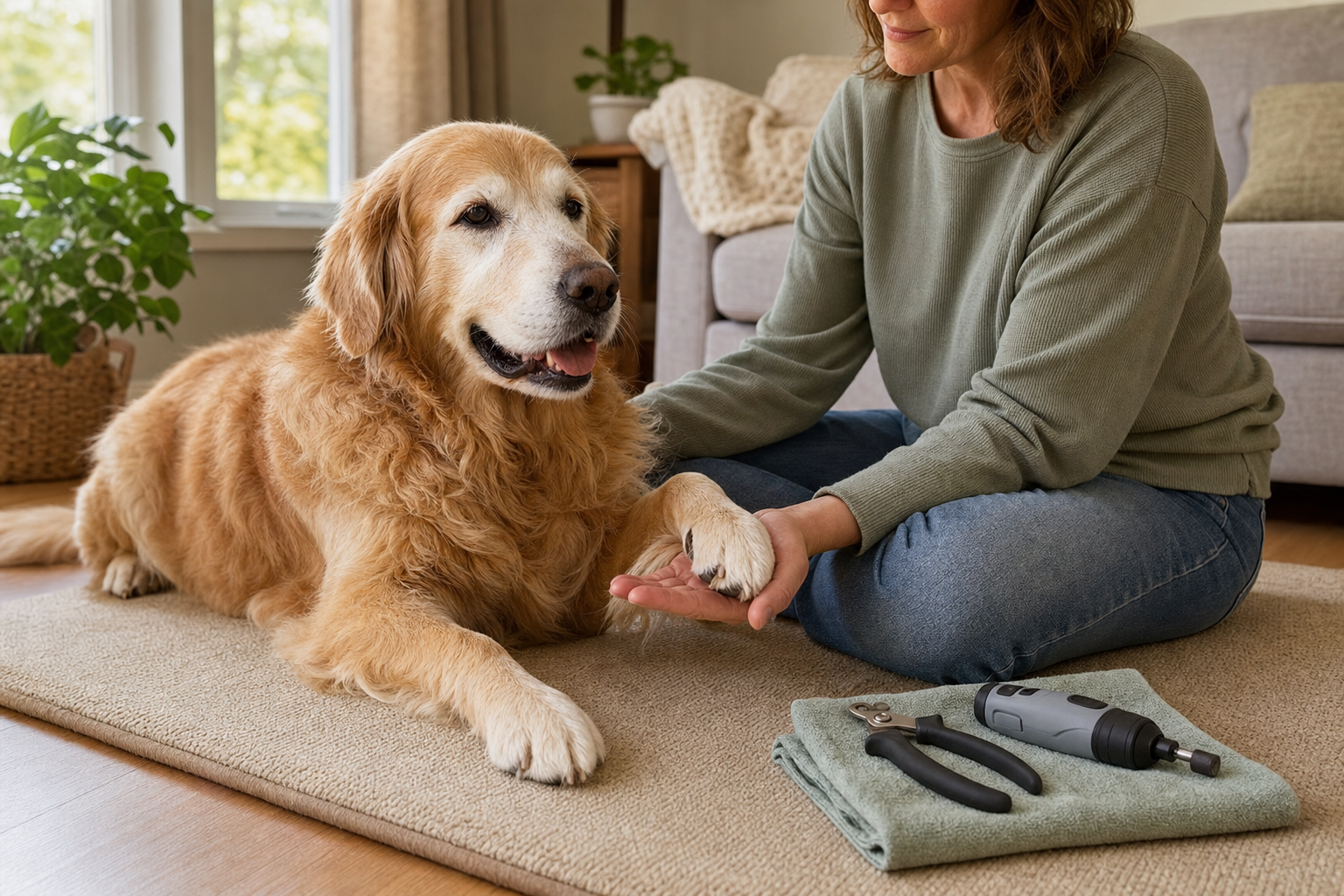
A nail grinder is not automatically gentler than clippers, and clippers are not automatically faster for every senior dog. The better choice is the tool your dog can tolerate while standing or lying on stable footing, with you able to see and control each small step.
If paw handling has suddenly become painful, your dog pulls away from a touch that was previously fine, or you see swelling, bleeding, a split nail, redness, discharge, or a change in gait, pause the home nail-care plan. Those are reasons to contact your veterinarian or a qualified groomer, not reasons to buy a different tool.
The quick choice: grinder, clippers, or professional help?
| Option | May suit | Main limitation | What to check first |
|---|---|---|---|
| Scissor- or plier-style clippers | A dog who accepts firm paw support and a brief cutting motion | One misplaced cut can reach the quick; thick or dark nails can be harder to judge | Blade sharpness, nail visibility, your hand control, and the dog’s response to the tool near the paw |
| Nail grinder | A dog who accepts motor sound and vibration and benefits from removing very small amounts at a time | Friction can heat the nail; hair can catch in the spinning tool; dust, vibration, and sound may bother the dog | Sound tolerance, coat clearance, speed control, sanding accessory, and whether you can use brief touches |
| Veterinarian or qualified groomer | A dog with pain, severe fear, difficult nails, or a caregiver who cannot safely see, position, or control the tool | Travel and handling can still be stressful, so the provider needs the full history | Ask how they handle fearful or painful senior dogs and whether veterinary support is needed |
The choice can change from dog to dog and even from paw to paw. A grinder may smooth a rough edge after clipping. Clippers may handle a small piece a grinder cannot safely reach. Some dogs need several training sessions before either tool comes near a nail.
Check tolerance before comparing features
Start without trimming. On a dry, nonslip surface, notice what happens when you touch your dog’s shoulder, move down the leg, and briefly support the paw. Then present the tool while it is off. For a grinder, switch it on at a comfortable distance before bringing it closer.
VCA advises watching the dog’s body language at each step. If the dog moves away, freezes, pants, trembles, repeatedly licks the lips, or becomes tense, stop and return to an easier step another day. Keep early sessions very short. The goal is not to distract the dog long enough to finish a nail. It is to find out whether the dog can participate without fear or force.
A senior dog may also tire quickly in one position. Let the dog lie down if that is more comfortable, as long as you can support the paw without twisting the leg. Do not make a weak dog balance on a narrow table, and do not use a hammock or forceful restraint to push through fear.
When clippers may be the simpler choice
Clippers make one quick cut. That can suit a dog who dislikes a motor and accepts a brief squeeze, especially when the nails are light enough to see the quick and the caregiver has good control.
VCA describes scissor- and guillotine-style clippers, but its handling guidance favors sharp scissor- or plier-style blades because a dull or one-sided cutting action may crush rather than cleanly cut the nail. Whatever style you use, it must match the nail thickness and feel steady in your hand.
Clippers may be a reasonable fit when:
- Your dog remains relaxed when the paw and individual toe are supported.
- The clipper fits around the nail without forcing the toe into an awkward angle.
- You can clearly judge a conservative cutting point.
- You can take tiny cuts instead of trying to reach the final length in one squeeze.
Pause the clipper plan when:
- The dog jerks the paw as the blades close.
- The nail is very thick, split, deformed, painful, or grown into the pad.
- Dark nails leave you unsure where to stop.
- Your hand strength, vision, or steadiness makes a controlled cut difficult.
On a light nail, VCA advises leaving a small margin before the visible quick. On a dark nail, take only a tiny amount at a time. If you cannot identify a safe stopping point, ask your veterinarian or groomer to demonstrate on your dog rather than relying on a generic diagram.
When a nail grinder may be the better fit
A grinder removes nail gradually and leaves a smoother edge. Some dogs who dislike the pressure or snap of clippers accept grinding better. Other dogs find the sound and vibration much harder. You cannot know which group your dog is in from age or breed alone.
Grinders also differ. Dremel’s current 7350-PETD is a cordless, single-speed tool listed at 12,000 rpm. Its 7760-PGKD is a variable-speed model listed from 8,000 to 25,000 rpm and includes an angled nail guard. Those details do not make one model universally safer. They show why “nail grinder” is too broad a label: speed range, guard design, sanding accessory, noise, vibration, size, and balance can change how controllable a tool feels.
A grinder may be a reasonable fit when:
- Your dog can hear the motor and feel light vibration without pulling away.
- You can keep long paw and leg hair clear of the rotating part.
- You can hold the tool steadily and touch the nail for only a moment at a time.
- You prefer gradual removal and can stop often to inspect the nail.
A grinder needs extra care because:
- Friction builds heat. Do not hold the sanding surface against one spot.
- Rotating parts can catch hair. Secure long hair away from the nail before switching the tool on.
- A slip can contact skin.
- Nail dust can irritate people and dogs. Work in good ventilation and keep dust away from eyes and noses.
- A guard can help with angle, but it does not locate the quick or replace careful handling.
Use brief touches, then lift the grinder away. Check the nail and your dog before continuing. If the nail feels warm, the dog flinches, or you lose a clear view, stop.
Our Senior Dog Grooming & Clean Home Products guide includes a current representative grinder and the setup questions to review before ordering. It is a research-backed selection, not a claim that we physically tested the tool or that grinding suits every senior dog.
When neither tool is the right home option
Home nail care is optional. It is not a test of whether you are a good caregiver.
VCA recommends personalized professional help when nail-care fear is established or severe. Veterinary guidance matters even more when a dog has painful joints, cannot stand comfortably, has a sudden behavior change, or may need medication to reduce fear and stress. A qualified groomer may be able to handle routine nails, but pain, infection, injury, or medication decisions belong with your veterinarian.
Do not disguise the tool with food and then trim while the dog is distracted. That may work once, but it can damage trust and make the next session harder. Food can support cooperative handling when the dog sees what is happening and remains comfortable; it should not be used to trick the dog through a feared procedure.
If professional grooming is the safer route, our guide to choosing a dog groomer can help you ask about senior-dog handling, breaks, surfaces, and communication.
Set up a short, controlled session
- Choose the position first. Use a wide, dry, nonslip mat at floor level. Let the dog stand or lie in the position that requires the least balancing.
- Use bright, even light. You need to see the whole nail, the paw hair, and the tool’s contact point without casting a shadow over the toe.
- Prepare before touching the paw. Put the correct tool, treats, good lighting, and pet styptic powder within reach. Keep the grinder switched off until the dog is settled.
- Practice on something else. VCA suggests learning the tool on items such as a straw or dry pasta before using it on a dog. This helps you feel the clipper action or grinder movement without rushing.
- Work on one small step. A successful session might be touching one paw, switching the grinder on across the room, or trimming one nail. You do not need to finish all four paws.
- Stop while the dog is still comfortable. Several short sessions are better than one session that ends in a struggle.
Keep styptic powder available for a minor quick cut and follow the product directions. If bleeding is heavy, continues despite first aid, or comes from a split or injured nail rather than a small trim, contact your veterinarian.
A simple decision path
- Is touch newly painful or is the nail injured? Stop and contact your veterinarian.
- Can your dog comfortably accept paw support? If not, work on cooperative handling or seek professional help before choosing a tool.
- Does the dog tolerate clipper movement better than motor sound and vibration? Consider sharp, properly sized scissor- or plier-style clippers and very small cuts.
- Does the dog tolerate the motor better than the clipper squeeze? Consider a controllable grinder, brief contact, clear hair, and frequent pauses.
- Are you unable to see the stopping point or control the tool steadily? Ask a veterinarian or qualified groomer to handle the trim or demonstrate a safe plan for your dog.
The useful question is not “Which tool is best for senior dogs?” It is “Which safe process can this dog and this caregiver manage today?” Sometimes the answer is clippers. Sometimes it is a grinder. Sometimes it is one nail with professional help, and that is a perfectly sensible choice.
Sources and research notes
- VCA Animal Hospitals: How to Trim a Dog’s Nails — clipper types, conservative trimming, the quick, grinder benefits and risks, dust, hair, and skin contact.
- VCA Animal Hospitals: Taking the Stress out of Nail Trimming for Dogs — body-language checks, short sessions, fear, trust, forceful restraint, and professional help.
- VCA Animal Hospitals: Handling Exercises for Trimming Nails and Brushing Teeth — nonslip setup, tool practice, desensitization, counterconditioning, styptic material, and session length.
- Dremel 7350-PETD product information and Dremel 7760-PGKD product information — current tool configuration, speed, battery, guard, dimensions, and warranty details checked August 4, 2026.
Well Walked Dog uses manufacturer and veterinary sources to explain selection and safety questions. We did not physically test the tools discussed here. Product specifications can change, so check the current manufacturer page and instructions before use.