A rear support sling can be handy when a senior dog needs a little help at the back end. A full-body support harness makes more sense when the front end also needs help, the dog needs support through repeated daily tasks, or you cannot keep the body level with rear support alone.
The choice starts with one question: what parts of your dog can still carry weight reliably? Then look at the exact job, such as getting up, taking a short bathroom walk, crossing a slippery area, or moving into a vehicle.
Talk with your veterinarian before treating a new mobility change as a gear problem. Pain, stiffness, a changed gait, reluctance to walk, trouble getting up, muscle loss, and sudden behavior changes can be signs of osteoarthritis or another condition that needs an examination. A support device may help with handling, but it does not diagnose or treat the cause.
Quick answer: match the support to what still works
A rear support sling may fit the task when:
- Your dog can bear weight through the front legs without buckling or veering.
- The help is brief and specific, such as standing up or taking a short, controlled bathroom walk.
- You can position the sling each time without twisting your back or rushing your dog.
- The support pad fits the belly and pelvis without pressing sensitive anatomy.
A full-body support harness may fit the task when:
- The front end is also unsteady, weak, painful, or unreliable.
- You need to support both the chest and pelvis while keeping the body more level.
- Your dog needs help several times a day and repeated sling placement is difficult.
- You need more control during short transfers, standing, or assisted walking.
If your dog cannot bear weight, collapses, seems painful, or has changed quickly, stop the home trial and call your veterinarian. Do not keep increasing the lift until a product appears to work.
What a rear sling does well
A rear sling places a broad support pad under the back half of the body. The caregiver holds straps or a handle above the dog and supplies only the amount of help needed. This can reduce the load on weak hind legs while allowing the front legs to guide the movement.
That narrow job is its strength. A rear sling is often quicker to put on for one short task, and many designs leave the front of the body free. It may suit a dog whose back legs need help but whose shoulders and front legs still provide steady support.
It also has a clear limit: rear support does not automatically stabilize the front end. If the shoulders dip, the front paws cross, or the dog leans hard to one side, lifting higher from behind can leave the body tilted rather than supported.
Rear-sling checks that matter
Do not choose by body weight alone. Current GingerLead sizing instructions tell owners to measure the available support-pad area from the front of the hind legs to the base of the rib cage. Male-dog anatomy changes where the pad can sit. The company also asks caregivers to measure the complete strap loop from the standing hand, under the dog, and back to the hand.
The current Walkabout Back End Harness instructions use two different measurements: the abdomen directly in front of the back legs and the upper thigh where it meets the body. That difference is a useful reminder. “Medium” is not a dependable measurement across brands.
Before ordering or using a rear sling, check:
- Where the pad will sit when your dog urinates.
- Whether the pad is wide enough to spread pressure without bunching into the groin or rib cage.
- Whether both sides can be adjusted to the same length.
- Whether you can stand upright while holding the handle.
- Whether the dog can keep using the hind legs rather than dangling from the sling.
GingerLead’s current instructions say to start on a flat surface, use only a little lift at first, and let a dog with some hind-end mobility use the legs. They also warn never to lift a dog completely off the ground while the attached lead is connected to a collar. Those are sensible boundaries for any rear-support trial.
What a full-body support harness changes
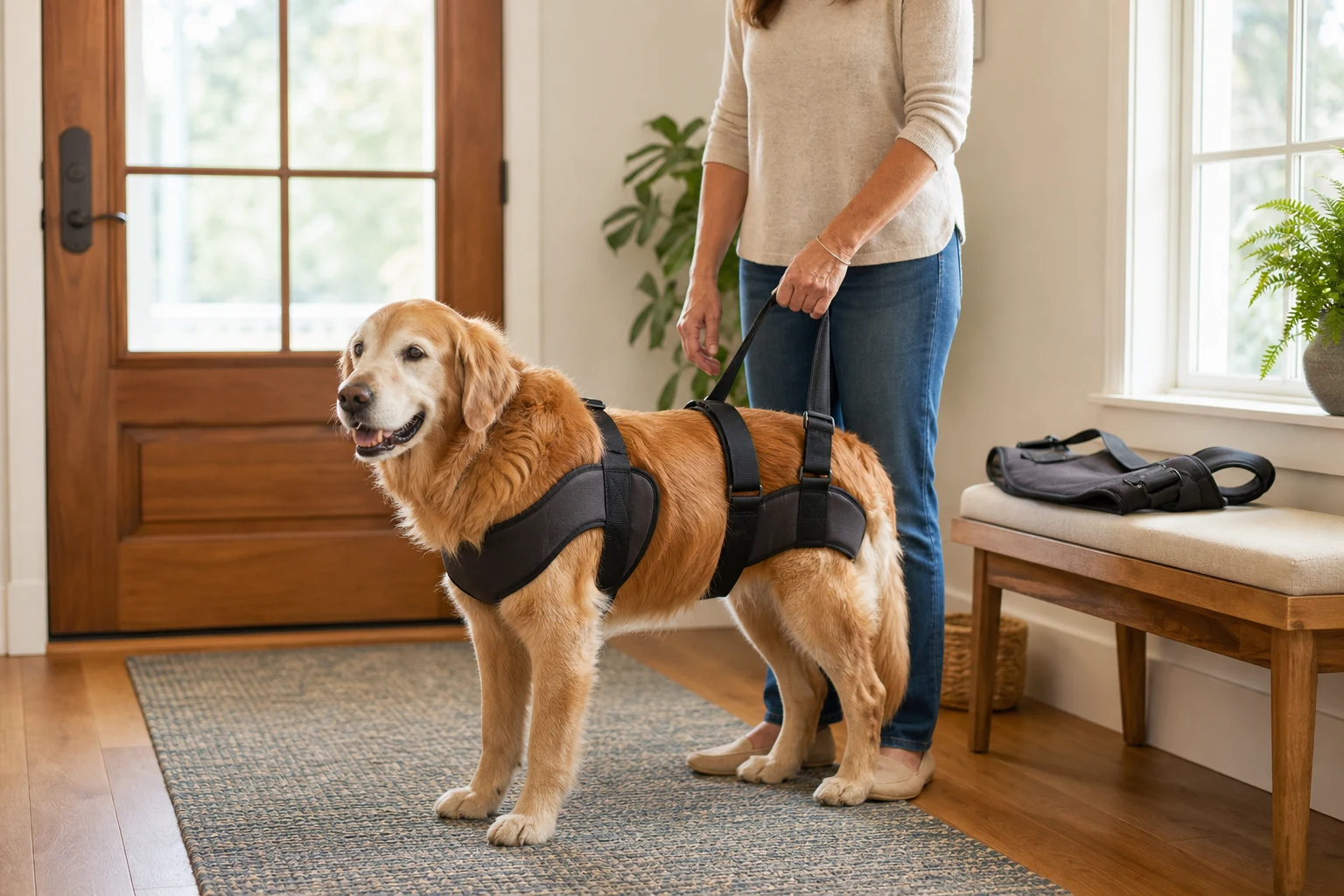
A full-body lifting harness connects front and rear sections so the caregiver can support the chest and pelvis together. That can help keep the dog’s body more level when rear-only support is not enough.
The tradeoff is complexity. A full-body harness has more straps, more fit points, more places where friction can develop, and more material to keep clean. It takes longer to fit correctly. It should not be treated as a carry handle that makes any lift safe.
The current Help ‘Em Up sizing guide starts with total body weight but also calls out body shape, hindquarter muscle loss, and barrel-shaped chests. Its front and rear sections can be mixed by size when one standard size does not fit both halves of the dog. The company also offers two rear-section shapes because male anatomy can affect urine clearance.
Its fitting instructions are just as important as the size label. The manufacturer says the harness should fit snugly, with regular checks for rubbing between the legs, along the torso, under the belly, and around the pelvis. It recommends breaks, removal at night, and loosening or unclipping straps when the dog lies down. The harness is machine washable and should air dry when possible.
Do not use a connected rear section by itself
Some full-body systems have a rear section that looks like a separate sling. That does not mean it is safe to use alone. Help ‘Em Up specifically warns that its rear Hip Lift must remain connected to the front section or it can slip off and cause injury. Follow the instructions for the exact design you own.
A five-step decision check
1. Watch a few ordinary steps
On a flat, non-slip surface, watch whether the front paws land evenly and the shoulders stay level. Do not force a test if your dog is painful or afraid. If the front end is unreliable, a rear-only sling is unlikely to give balanced control.
2. Name the exact job
“Needs mobility help” is too broad. Write down the task: rise from a bed, walk 20 feet to the yard, steady during toileting, cross a doorway, or transfer into a vehicle. A device that works for a short bathroom trip may be awkward for a car transfer.
If the main problem is getting into a vehicle or onto furniture, compare access equipment too. Our dog ramp versus steps guide explains what to measure before choosing either one.
3. Measure the dog and the caregiver
Measure exactly where the manufacturer tells you. Also check the caregiver’s reach and balance. A handle that leaves you bent at the waist can turn a brief assist into an unsafe lift for both of you.
4. Rehearse on level ground
Introduce the device when nobody is rushing. Keep all four paws on the floor, use light support, and reward calm steps. Check the skin and fur after a few minutes. Stop if the dog freezes, twists, pants heavily, vocalizes, or fights the equipment.
5. Recheck the fit during real use
Straps can loosen, pads can shift, and a senior dog’s body shape can change over time. Recheck urine clearance, skin contact, buckles, and even strap length. Weight loss and hindquarter muscle loss can make last month’s fit wrong today.
When neither option is enough
A sling or harness cannot make every transfer safe. Ask for veterinary or rehabilitation guidance when:
- Weakness or gait changes appeared suddenly.
- Your dog cannot rise or bear weight without being held up.
- The front legs buckle, cross, or slide while you support the rear.
- Your dog shows pain, panic, or new irritability during handling.
- You cannot support the dog without straining your back, shoulders, or balance.
- The device presses on a surgical site, skin sore, mass, or painful area.
Cornell’s veterinary guidance notes that osteoarthritis can cause pain, stiffness, changed gait, reduced activity, trouble with stairs, difficulty rising, muscle loss, and behavior changes. A veterinarian can examine the gait and joints, identify the likely cause, and help decide whether assisted walking is appropriate.
Current product-policy details worth checking
Fit-sensitive support equipment can be hard to judge until it is carefully tried on indoors. Return and warranty terms therefore matter more than they do for a simple household item.
- Help ‘Em Up currently lists a 14-day exchange window, a 30-day return window for direct orders shipped to the United States and Canada, condition-based fees, and a one-year manufacturing warranty.
- GingerLead currently lists a 10-day satisfaction-return period and a 60-day warranty against defects in components and workmanship.
- Walkabout’s current refund-policy page says 20 days, while its FAQ says 15 days. Confirm the applicable deadline with the company before ordering.
Policies can change. Read the current terms for the exact seller and product before purchase. We checked these manufacturer pages on August 21, 2026.
How the links work: The product links in this article open current manufacturer instructions and policies. They are ordinary, non-affiliate links. Well Walked Dog earns nothing if you visit or buy from them.
Rear sling or full-body harness?
Choose rear support when the front end is still dependable and the job is brief. Move toward balanced full-body support when the front end also needs help or repeated daily handling calls for more control.
Whichever design you consider, fit and task matter more than the product label. Measure the dog, check your own lifting position, start on level ground, and stop if the equipment creates pain, fear, rubbing, or a tilted body.
For current product examples and measurement links, see the Senior Dog Mobility & Support Products guide.
Sources
- Cornell University College of Veterinary Medicine: Osteoarthritis
- Help ‘Em Up: Choosing a Harness
- Help ‘Em Up: Choosing a Hip Lift
- Help ‘Em Up: Fitting the Harness
- Help ‘Em Up: Exchanges and Returns
- Help ‘Em Up: Manufacturing Warranty
- GingerLead: Sizing
- GingerLead: Instructions and Washing
- GingerLead: Guarantee, Returns, and Warranty
- Walkabout: Original Back End Harness
- Walkabout: Refund Policy
- Walkabout: FAQ