A dog car seat cover can protect upholstery. A hammock-style cover can also block the open footwell and discourage a dog from moving toward the front seats. Neither one restrains your dog in a sudden stop or crash.
That distinction matters for any dog, but it is especially easy to blur when an older dog needs a steadier place to rest. Start by naming the job you need the product to do: protect the seat, cover the footwell gap, or restrain the dog. You may need more than one piece of equipment.
The short answer: a cover and a restraint do different jobs
| Product type | Main job | What it does not prove |
|---|---|---|
| Bench seat cover | Protects the seat from hair, dirt, moisture, and claw marks | It does not keep a dog in place during a sudden stop |
| Hammock-style seat cover | Protects the seat and covers the gap between the rear and front seats | It is not a crash restraint or a substitute for one |
| Vehicle restraint harness, secured carrier, or secured travel crate | Limits a dog’s movement according to the exact product’s design and installation | A label such as “travel” or “crash tested” does not tell you the test method, fit, or result |
The American Veterinary Medical Association advises safely restraining dogs during car travel. It also advises keeping dogs out of the front passenger seat when the vehicle has airbags and never allowing a dog to ride on the driver’s lap. A surface cover can be part of that setup, but it does not replace the restraint.
Choose a bench cover when the seat itself is the problem
A bench cover is the simpler option. It lies across the rear seat and may include flaps for the seat front or doors. It can make cleanup easier after a muddy walk, an accident, or a wet trip.
For a senior dog, material and fit matter more than a long feature list. Check the installed cover with the vehicle parked:
- Press and pull at the surface. It should not slide, bunch, or expose a slick patch when the dog turns.
- Make sure seams, buckles, and anchors do not create a hard pressure point where the dog lies.
- Keep every restraint attachment and seat-belt path required by the restraint manufacturer accessible.
- Check whether a door flap can catch a paw or move underfoot during entry.
- Confirm the care directions fit the mess you are trying to manage. “Water resistant” and “waterproof” are not interchangeable claims.
A cover that protects the car but shifts under your dog is the wrong tradeoff. Older dogs may already have trouble with balance, rising, or turning. New stiffness, pain, a changed gait, or reluctance to jump can occur with osteoarthritis, according to Cornell’s canine osteoarthritis guidance. Mention a new change to your veterinarian rather than treating it only as a car-equipment problem.
Choose a hammock only if you need to cover the footwell gap
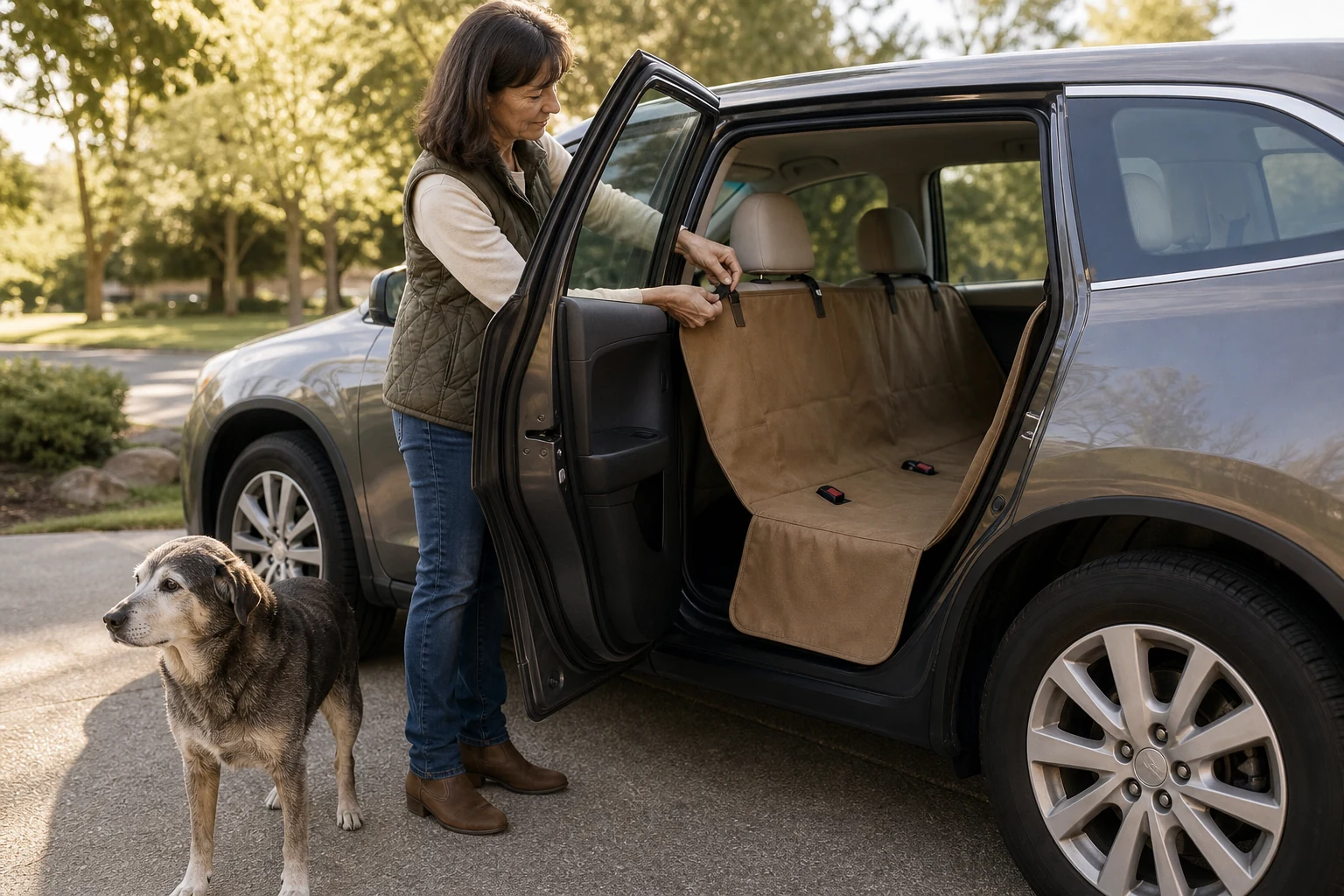
A hammock-style cover attaches near the front and rear headrests while resting on the rear bench. Its front panel spans the gap between the seats. This can help keep a dog from stepping into the footwell, but the bench underneath still carries the dog.
Do not hang a fabric hammock over an open space and assume it creates a supported platform. For example, Kurgo’s current Rover Hammock instructions say the product is designed for vehicles with a bench seat under it and should not be used over an open space or with bucket seats. That model is listed as 55 inches wide by 56 inches long; Kurgo tells buyers to measure the seating width before ordering. The page also describes seat-belt and LATCH openings, eight attachment points, spot cleaning or hand washing, and air drying.
Those are manufacturer specifications for that exact model, not proof that every hammock fits or behaves the same way. They also do not turn the cover into a crash restraint. Kurgo lists its car restraints separately from its hammocks, and the Rover page does not describe a crash-test protocol for the cover.
Measure the installed setup, not only the product
A package dimension tells you whether a cover may span the seat. It does not tell you whether your senior dog can enter, turn, lie down, and remain clear of the restraint hardware.
- Rear-seat width: Measure the usable bench from left to right, not the vehicle’s exterior width.
- Door opening and sill: Watch the dog’s approach while the car is parked. A good riding surface does not fix a difficult jump into the vehicle.
- Resting space: Confirm that the dog can sit and lie down after the restraint is installed correctly.
- Buckle access: Openings must line up with the exact belt path or anchor required by the restraint. Do not reroute a belt to accommodate the cover.
- Surface stability: Check the cover over the full turning area. A grippy patch in one corner does not help if the middle slides.
- Human passenger space: If someone will share the rear seat, verify that both the passenger belt and the dog’s restraint can be used as designed.
Add the restraint as a separate decision
Once the surface is sorted out, choose the restraint based on the dog’s size, mobility, body shape, tolerance, and the vehicle. Our guide to a dog car harness versus a carrier or travel crate explains what to measure and why testing language needs a careful read.
The Center for Pet Safety certified-products page separates safety harnesses, travel carriers, and travel crates. Seat covers and hammocks are not listed as restraint categories. Certification is not the only information you may consider, but the categories reinforce the basic boundary: a cover manages the seat surface; a restraint manages the dog’s movement.
Do not add an extension tether, clip, or alternate belt route unless the restraint maker instructs you to use it with that exact model. The Center for Pet Safety warns that extension tethers can add dangerous movement and can defeat a harness maker’s crash-protection claims. The cover should fit around the restraint setup, not force you to improvise it.
Run a parked-car rehearsal
- Install the cover or hammock exactly as its manufacturer directs.
- Install the restraint separately, following its own instructions.
- Help the dog enter using the normal step, ramp, or lift routine.
- Watch one slow turn, sit, and lie-down attempt. Stop if the dog scrambles or a strap crosses a leg.
- Check every anchor and buckle again after the dog changes position.
- Take a short, quiet practice ride before a longer trip, if your veterinarian has not advised against travel.
Do not keep rehearsing through pain, panic, breathing trouble, weakness, stumbling, or a sudden loss of balance. Those signs need veterinary guidance. A different cover cannot make an unwell dog ready for travel.
Check care, returns, and warranty before ordering
Care instructions can decide whether a cover works for everyday senior-dog life. If accidents are part of the reason you need one, confirm whether the whole cover can be washed, whether it must be hand cleaned, and how long it needs to air dry. Check the return policy before allowing the dog to use it, since used products may not remain returnable.
For the Rover example, Kurgo’s current return page gives direct buyers 45 days and says returns must meet its stated condition and packaging rules. Purchases from other retailers follow that retailer’s policy. Kurgo’s warranty page covers manufacturing defects during the product’s lifetime but excludes damage from unintended use. Policies can change, so read the current terms at the place you buy.
The practical choice
Choose a bench cover for surface protection. Choose a hammock-style cover when you also need to block the footwell gap and your vehicle has a supported rear bench that matches the instructions. Then choose and install a separate restraint for the dog.
If you are building the whole setup, compare the current Senior Dog Travel & Car Access guide. It organizes restraint, entry, seat protection, hydration, and portable rest by the job each item is meant to do.