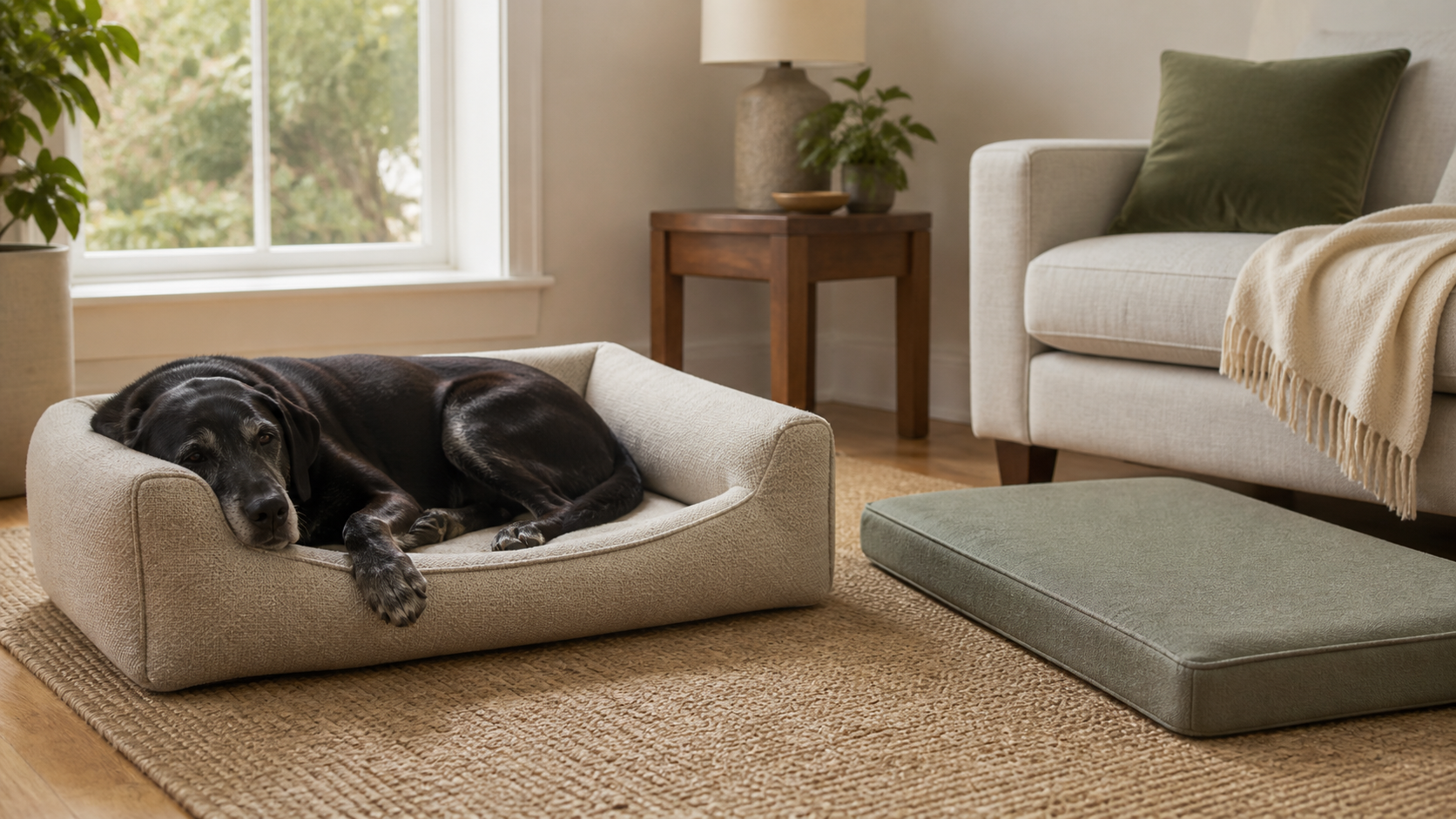
Your senior dog may love sleeping with their head against a raised edge. That does not automatically mean a full bolster bed is the right choice. The same edge that feels useful at rest can take away stretching room, narrow the way in, or make a sleepy exit harder.
The choice is not simply “bolster or no bolster.” First decide what job the edge needs to do. Then watch how your dog approaches the bed, settles, changes position, and gets up. A one-sided headrest, a three-sided sofa bed, an open contour, and a flat mattress ask different things of an older dog.
This guide focuses on that boundary decision. For the broader checks on bed thickness, total sleeping area, floor grip, washing, and fluid protection, use our supportive senior dog bed guide.
The short answer
A low bolster may suit a dog who regularly leans or rests their head against a firm boundary and can still use the opening without hesitation. A flat bed may suit a dog who stretches, approaches from different directions, drags a paw, or needs the least complicated route on and off.
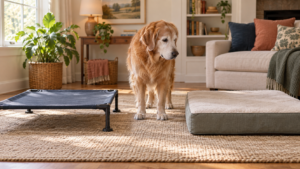
There is useful middle ground. A single headrest leaves three sides open. A three-sided bed gives more boundary but directs the dog toward one entrance. A contoured lounger can provide a slope without a separate wall. Pick the layout that matches your dog’s actual movement, not the style that looks coziest in a product photo.
Start with the resting job
Watch several ordinary naps before shopping. You are looking for a repeated preference, not one unusual night.
- Head support: Does your dog repeatedly place their chin or cheek on a couch arm, folded blanket, or bed edge?
- Body boundary: Do they settle more easily when their back touches something, or do they move away from raised sides?
- Open sprawl: Do their legs extend beyond the current bed, or do they rotate through curled, side-lying, and stretched positions?
- Easy exit: Do they step out through one opening, climb over the nearest edge, or pause as if deciding how to leave?
A dog who uses an edge only as a pillow may not need bolsters on three sides. A dog who regularly presses their back against a boundary may use more of one. If your dog changes position often, open space can matter more than the edge.
Compare four bed layouts
| Layout | What it may offer | Main tradeoff to check |
|---|---|---|
| Flat mattress | Open approach and exit from every side | No built-in edge for a dog who seeks one |
| One-sided headrest | A place for the head or back while three sides stay open | The raised section still reduces part of the usable surface |
| Three-sided bolster | A longer boundary around the resting area | One planned opening and less room inside the outer dimensions |
| Open contour | A shaped or sloped surface without a separate wall | The slope may guide the body into a position your dog does not choose |
Current manufacturer lines show why the layout name is not enough. Big Barker lists its Original in sleek, headrest, and sofa styles, while its Junior line lists headrest and sofa versions. FurHaven describes the Luxe Lounger as an open, sloping contour with step-on access. K9 Ballistics lists a flat rectangular orthopedic bed with a removable cover, liner, and nonskid bottom. These are construction examples, not proof that one bed treats pain or fits every senior dog.
Measure the opening and the space inside
Outside dimensions can make a bolster bed look roomy while the inner sleep surface is much smaller. Ask the manufacturer for the inside length and width if those measurements are not published. If there is one entrance, measure its clear width and the height of any lip your dog must cross.
- Measure your dog in the largest position they normally use.
- Add the space needed to turn without folding against a wall.
- Compare that footprint with the space inside the bolsters, not the outside seam.
- Measure the lowest entrance from the floor after the bed is fully expanded.
- Check whether the opening lines up with the clear path your dog already uses.
Do not assume that a soft bolster will simply flatten when stepped on. A collapsing edge can shift under a paw, while a firm edge can become a step. Either way, the entrance needs to work when your dog is tired as well as when they are alert.
Test the route, not only the bed
Place the planned opening toward the easiest approach. Leave enough clear floor for your dog to turn without backing into furniture. Press down and sideways at the entrance to see whether the whole bed slides or the cover wrinkles under a paw.
AAHA’s senior-care guidance includes appropriate bedding and home changes that improve footing. Cornell’s osteoarthritis guidance also discusses non-slip surfaces as part of a broader veterinary management plan. That supports checking the bed and the path together. It does not make a particular bolster, foam, or brand medically necessary.
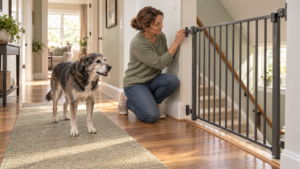
If the route to the bed is the bigger problem, our senior dog home safety route audit can help you check floor transitions, lighting, turns, and the path to water or the door.
Who may do better with an open surface
A flat or broadly open bed deserves a closer look when your dog approaches from several directions, sleeps stretched out, has trouble lifting a paw over a small edge, or needs room for a caregiver to help with positioning. Open access can also make it easier to place a smooth protective layer without blocking one narrow entrance.
Open does not mean effortless. A thick flat mattress still creates a step. A light bed can slide. Deeply compressible fill can make standing harder for some dogs. Check total height, edge firmness, surface traction, and floor grip separately.
Who may use a raised edge well
A headrest or low bolster may fit a dog who consistently seeks a boundary and can enter and leave through the open side without clipping the edge. A one-sided design is often the simplest way to preserve that option without surrounding most of the bed.
For a three-sided bed, check where your dog will put their head, whether the entrance stays open after adding a protector, and whether the inner area allows a full turn. Watch for the dog sleeping partly outside the bed because the usable surface is too short. That is a fit clue, not stubbornness.
Use a low-risk home check before replacing the bed
You can test the resting preference without building a high wall or forcing a new sleep position. Place a firmly rolled towel outside the cover along one edge of the current bed, where it cannot unroll or create a loop. Supervise the trial and remove it if your dog chews bedding, gets tangled, or has trouble repositioning.
The point is to observe whether your dog chooses the boundary, ignores it, or moves away. This is not a treatment test, and it should not delay veterinary care. Skip the towel trial when your dog tears or swallows fabric, cannot reposition independently, or needs a prescribed positioning plan.
Know when the bed decision needs veterinary input
Contact your veterinarian if your dog has new trouble lying down or rising, a changed gait, stiffness, reluctance to move, repeated nighttime restlessness, signs of pain, or skin redness and sores. A sudden change in where or how a dog sleeps can be useful information for the clinic.
A bed can change the resting surface and route. It cannot diagnose arthritis, relieve untreated pain, or prevent pressure injuries in a dog who cannot change position. Dogs with major mobility limits, neurologic problems, recent surgery, or skin wounds may need specific bedding and repositioning instructions from their veterinary team.
A final bolster-or-flat checklist
- I know whether my dog seeks a headrest, a body boundary, or open sprawl space.
- I measured the usable inner surface, entrance width, and lowest edge.
- The opening faces a clear, stable approach route.
- My dog can turn, settle, and leave without climbing over a raised side.
- The bed and cover stay put when weight reaches the entrance.
- I checked which parts are removable, washable, and safe for my dog’s chewing behavior.
- I know the current return policy in case the layout does not work at home.
For current researched examples of flat, headrest, sofa, contour, elevated, and travel layouts, visit the Senior Dog Beds & Rest Products guide. It records manufacturer dimensions, care instructions, and limitations without claiming hands-on testing.
Editorial review and sources
This article was researched and reviewed by the Well Walked Dog Editorial Team on September 4, 2026. It provides general educational information and is not a diagnosis or a substitute for veterinary care. We did not physically test the beds discussed.
- 2023 AAHA Senior Care Guidelines for Dogs and Cats: senior mobility, pain assessment, home footing, and appropriate bedding.
- Cornell Richard P. Riney Canine Health Center: Osteoarthritis: movement changes, veterinary assessment, and home modifications.
- Big Barker Original manufacturer page: current sleek, headrest, and sofa configurations.
- Big Barker Junior manufacturer page: current headrest and sofa configurations.
- FurHaven Luxe Lounger manufacturer page: open contoured construction, step-on description, cover care, foam care, and chewing limitation.
- K9 Ballistics Tough Ripstop Rectangle manufacturer page: flat rectangular construction, removable components, dimensions, and nonskid base.