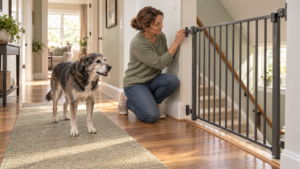
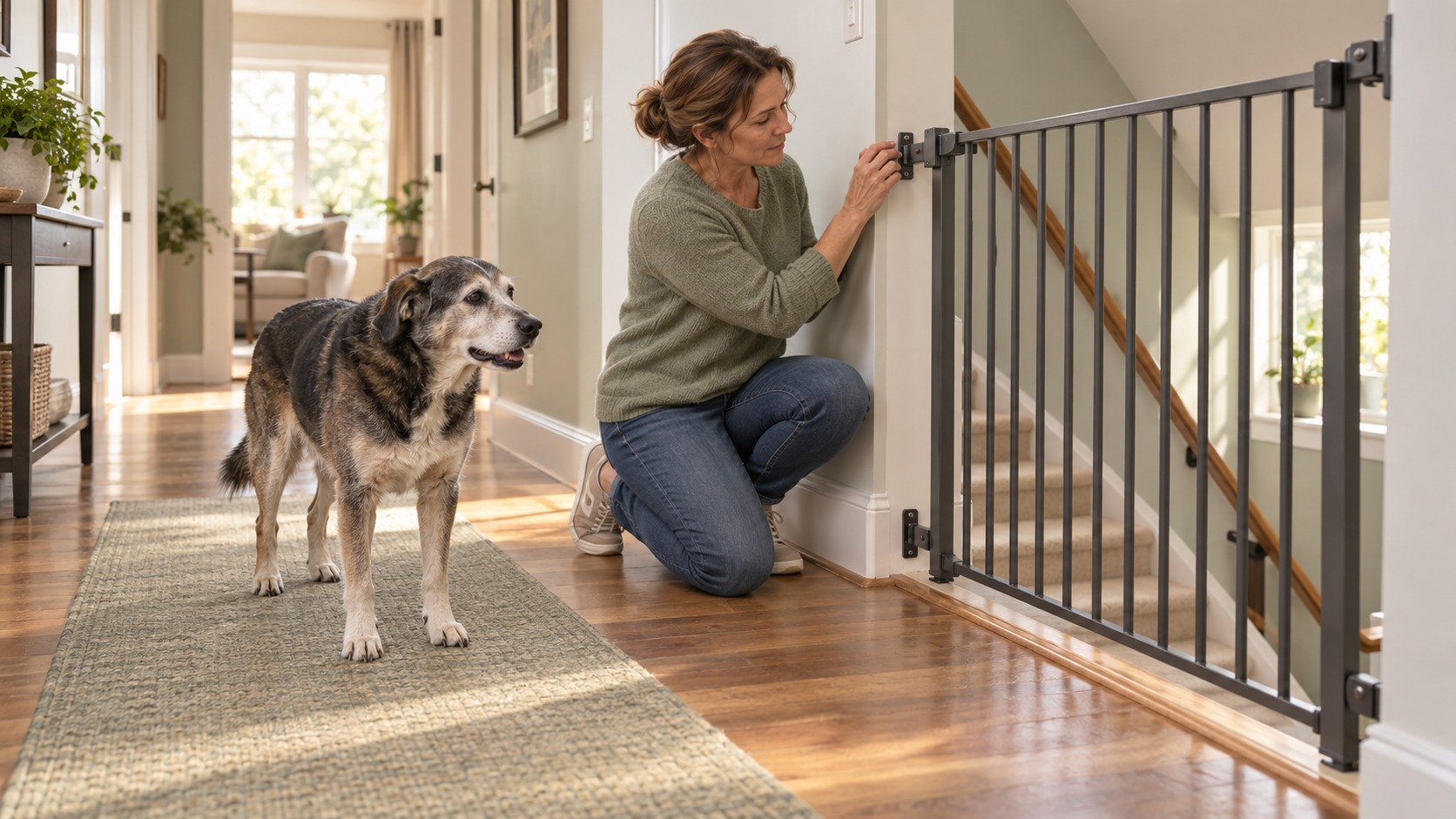
A pet gate can keep a senior dog away from stairs or a room that is no longer safe to enter alone. The mounting method matters, but location comes first. A pressure-mounted gate that makes sense across a level hallway may be the wrong choice at the top of a staircase.
Start by deciding exactly what the gate must block. Then measure the opening, inspect the walls or posts, look at the floor-level frame, and watch how your dog approaches the area. The easiest gate to install is not useful if it shifts, leaves a squeeze-through gap, or adds a bar that people and paws keep catching.
The short answer
Use a gate only where its manufacturer approves that exact mounting method. For a top-of-stairs opening, choose a hardware-mounted gate specifically approved for stair use and follow its current instructions. Do not treat a no-drill pressure fit as interchangeable with a wall-mounted installation.
| Gate type | Where it may fit | Main check |
|---|---|---|
| Pressure-mounted | A level doorway or hallway when the manufacturer approves the location | Confirm the pressure points, opening range, floor-level frame, and whether the gate stays secure under the forces your dog may apply |
| Hardware-mounted | Stairs or another opening where the exact gate is approved and suitable structure is available | Confirm the wall or post structure, fasteners, swing direction, latch placement, and every installation clearance |
This is an access-control choice, not a mobility treatment. A gate stops entry. It does not add traction, make stairs easier to climb, or explain why a dog has suddenly become hesitant.
Choose the mounting method from the location
At the top of stairs
Use only a gate and installation method that the manufacturer explicitly approves for top-of-stairs use. The hardware-mounted Cardinal Gates SS-30 is presented by its manufacturer for stair placement. Its current design mounts to the walls, can be installed at an angle when the approved structure allows it, and includes a stop that can limit the opening direction.
That last detail matters. A stair gate should not swing into the stair opening when the instructions require a setup that opens away from the stairs. The latch and hinges also need solid attachment points. Screws driven only into unsupported drywall are not the same as a connection to suitable framing or an approved anchor system.
Do not improvise around banisters, baseboards, or an angled opening. Use compatible installation hardware and the exact current instructions. If the available structure does not match the manual, ask the manufacturer or a qualified installer before drilling.
Across a level doorway or hallway
A pressure-mounted gate may be reasonable when the manufacturer approves the location and the opening falls inside its stated range. The current Cardinal Gates XTPPG page, for example, describes a no-drill pressure fit for level indoor openings and states that the model is not suitable for the top of stairs.
No drilling does not mean no measuring. Pressure feet need suitable opposing surfaces. Decorative trim, uneven walls, loose posts, or a baseboard that changes the width can interfere with the fit. Measure where the upper and lower contact points will land, not only at eye level.
Look at the complete frame too. Some walk-through designs have a floor-level bar. That may be manageable in one doorway and a poor fit in a route used at night, by a person carrying laundry, or by a dog that shuffles its feet. Check the exact model rather than assuming every pressure-mounted gate has the same threshold.
At the bottom of stairs
The bottom of a staircase is still a stair location, but it is not identical to the top. Read the gate’s approved-location language and installation instructions. Check whether the door can open without blocking a landing, striking a handrail, or directing the dog toward the first step.
If the dog should never use the stairs without help, the gate needs to support that routine every time. A gate left open for convenience is not a barrier.
Measure the opening and the route
Take measurements at the exact points where the gate will sit. Openings are often narrower at a baseboard or wider near an uneven post.
- Measure the width at the top, middle, and bottom. Use the narrowest relevant measurement and compare it with the manufacturer’s approved range.
- Identify the mounting surface. Note studs, wood posts, metal railing, masonry, drywall, trim, and baseboards. Do not guess which fastener a surface needs.
- Check the full swing. Open the proposed gate through its complete permitted arc. It should not swing over stairs, hit furniture, cover a light switch, or trap someone in a narrow landing.
- Inspect the floor route. Look for a bottom bar, raised edge, loose rug, slick patch, or tight turn immediately before and after the gate.
- Measure the dog, not just the doorway. Compare gate height, bar spacing, and the permitted floor gap with your dog’s size, body shape, jumping, climbing, and squeezing behavior.
The SS-30 product page currently lists a 27 to 42.5 inch opening range for the aluminum version and a 29.5 inch gate height. The XTPPG page lists a 29.5 to 32.5 inch base range, a 36 inch height, a 24 inch walk-through door, and optional extensions. Those numbers belong to those named models. They are not standard dimensions for all gates.
If an extension is needed, verify the exact extension combination allowed for that gate. Do not stack unrelated parts or use a near-fit because the product names sound similar.
Check what your senior dog may do at the gate
Age does not make every dog passive. A senior dog may still push, lean, paw, jump, climb, or try to squeeze through when family members are on the other side. Others may stop abruptly, back up, or become anxious when a familiar route changes.
Before choosing a gate, watch the dog near the opening while you are present. Consider these questions:
- Could the dog fit beneath the allowed floor gap or between the bars?
- Does the dog push barriers with the chest or paws?
- Can the dog jump higher than the proposed gate?
- Does the dog become distressed when separated from the family?
- Will the gate block the shortest route to water, rest, or the potty door?
- Could a floor bar or tight turn catch a shuffling paw?
Manufacturers do not always publish a dog-weight limit. Do not create one from the gate height, material, or marketing language. If your dog’s behavior puts more force on the barrier than the instructions address, ask the manufacturer whether the model is suitable.
Keep the broader home route in view. The senior dog home-safety route audit helps you trace the trip between bed, water, the potty door, and family areas before blocking an opening. If slick flooring is part of the problem, use the separate guide to choosing a stable rug runner. A barrier and a traction path solve different jobs.
Test the installed gate before relying on it
Follow the manual supplied with the exact gate. After installation, test the setup without the dog near the stairs.
- Close and latch the gate several times. Confirm that the latch fully engages each time.
- Apply firm hand pressure at different heights in the directions your dog might push. Stop if the frame shifts, twists, loosens, or pulls away from the mounting surface.
- Check every fastener, pressure foot, hinge, extension joint, and stop. Compare the final setup with the manual, not with a retailer photo.
- Walk through from both directions. Notice the floor bar, landing space, hand position, and anything you could catch while carrying an item.
- Confirm that the gate cannot open toward the stairs when the instructions require the opposite direction.
- Introduce the closed gate while the dog is supervised. Reward calm observation. Do not encourage jumping, pawing, or squeezing as a test.
Recheck the gate after cleaning, a hard impact, a move, or any sign of looseness. A pressure-mounted gate can lose its intended fit if contact points shift. A hardware-mounted gate still needs its latch, fasteners, stop, and wall connection inspected.
Before ordering, confirm the return and warranty terms for the seller you will use. Cardinal Gates currently states that returned items must be in new condition and original packaging, with timing-based terms, and lists a one-year residential manufacturer-defect warranty for eligible purchases used according to its instructions. Recheck the policy before buying, especially if the installation may require opening hardware packages or drilling.
When a gate is not the whole answer
A gate can manage access while you work out why the route changed. Call your veterinarian about new or worsening weakness, repeated falls, pain, stiffness, a gait change, difficulty rising, new trouble with stairs, or disorientation. Contact the clinic promptly if your dog cannot stand, seems acutely painful, collapses, or is suddenly unable to use a familiar route.
Cornell’s canine osteoarthritis guidance lists stiffness, lameness or gait changes, reduced activity, trouble with stairs or jumping, and difficulty rising among the signs owners may notice. Home changes can support a veterinary plan, but they do not diagnose or treat the cause.
If your dog still needs supervised stair access, compare the physical demands and measurements in the senior dog ramp-versus-steps guide. When stairs should be off-limits, use the Home Safety & Daily Living guide to review the barrier as one part of the whole route.
Editorial review and sources
Well Walked Dog did not hands-on test these gates. We compared current manufacturer product pages, installation material, and policy information, then used veterinary guidance to keep the home-safety advice within an appropriate boundary. Specifications and policies can change. Check the exact model and current instructions before ordering or installing.
- Cardinal Gates: Stairway Special Pet Gate (SS-30)
- Cardinal Gates: Extra Tall Premium Pressure Gate (XTPPG)
- Cardinal Gates: SS-30 installation infographic
- Cardinal Gates: Warranty and returns policy
- Cornell University College of Veterinary Medicine: Osteoarthritis
This article contains no affiliate links, prices, ratings, copied reviews, or availability claims.